
All about beer
Brewing a lager at home
Pils, helles, märzen, schwarzbier: lagers are the most drunk beers in the world and the least brewed at home, because they need cold and time. Yet nothing in the brewing itself differs from an ale; everything happens at fermentation. And a lager is less forgiving: clean and crisp, it shows the slightest fault. This page explains what changes, gives the figures and proposes a timetable for a 20-litre pils. Winter, in an unheated room, is the ideal season to get started.
Updated on 23 October 2026
What changes
| Ale | Lager | |
|---|---|---|
| Yeast | Saccharomyces cerevisiae, top fermentation | Saccharomyces pastorianus, bottom fermentation |
| Fermentation temperature | 18 to 22 °C | 9 to 13 °C |
| Amount of yeast | 1 sachet of 11 g for 20 L at 1.050 | 2 sachets, or a 2 to 3 L starter; about double |
| Fermentation time | 7 to 14 days | 14 to 21 days, plus a diacetyl rest |
| Conditioning | Optional | 3 to 8 weeks at 0-4 °C |
| Character | Fruity esters, depending on the strain | Neutral: malt and hops laid bare |
| From brew to glass | 4 to 5 weeks | 8 to 12 weeks |
The yeast: twice as much
At 10 °C, yeast multiplies slowly; if you pitch too little, it takes days to start, bacteria take advantage and it produces more unwanted compounds (sulphur, acetaldehyde, diacetyl). The brewers' rule: 1.5 million cells per millilitre and per degree Plato for a lager, against 0.75 for an ale. For 20 litres at 1.050 (12.4 °P): about 370 billion cells, i.e. two 11 g sachets of dry yeast, or a 2 to 3 litre starter from one pack of liquid yeast (the yeast pitching rate tool and the yeast starter tool do the maths). Modern dry lager yeasts are reliable and simple; rehydration according to the instructions matters more than for an ale.
Fermentation
- Chill the wort down to fermentation temperature, 10 to 12 °C, before pitching. Pitching at 20 °C "to get it started" then chilling is a classic cause of esters and sulphur. If you cannot get any lower, pitch at 14-15 °C and chill within the first hours.
- Oxygenate the wort well: cold and with a lot of yeast, the need is greater than for an ale; shake the closed fermenter vigorously for several minutes.
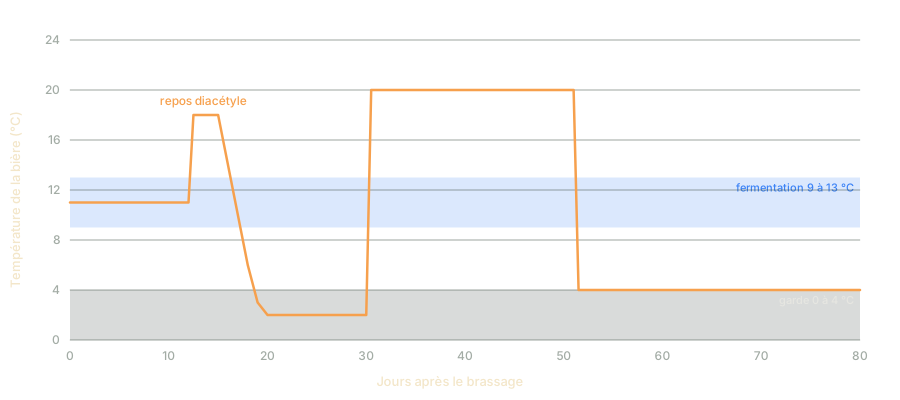
- Hold 9 to 13 °C for 10 to 14 days. Activity is slow and quiet: no spectacular krausen, and a normal sulphur smell.
- Diacetyl rest: when the gravity is 2 to 4 points from the expected final gravity (for example 1.016 for a final gravity of 1.012), let it rise to 17-18 °C for 2 to 3 days. The yeast finishes fermentation and reabsorbs the diacetyl. Without this rest, the lager smells of butter, the most frequent fault of homemade lagers (see off-flavours).
- Check that the final gravity is stable over two readings, then chill.
Lagering
The word lager comes from the German for "to store". At 0-4 °C for 3 to 8 weeks, the yeast and the haze drop, the sulphur evaporates, the flavours blend. You can do it:
- In the fermenter, before bottling: the beer is brilliant at racking, but little yeast is left for refermentation; add a pinch of dry yeast at priming.
- In the bottle, after refermentation: 3 weeks at 20 °C to take on the gas, then the bottles in the cold for the lagering. Simpler for anyone with only one cold space.
- In a keg, under pressure: the most practical method when you have one.
Without a cellar or a dedicated fridge
- Winter: an unheated room, a garage, a larder, a stairwell often hold 8 to 14 °C from December to February. A min-max memory thermometer placed there a week ahead tells you whether the spot is suitable. It is the traditional season for lagers.
- A water bath: the fermenter in a large tub of water, with frozen water bottles changed morning and evening, holds 10-12 °C in a room at 18 °C and smooths out variations.
- "Lager at ale temperature" yeasts: some dry strains give a clean beer at 15-18 °C, and a few kveik or hybrid strains imitate a lager at 20 °C (see brewing with a kveik). The result is not a lager in the strict sense, but a crisp, ester-free beer that comes very close.
Fermenting under pressure
Another way, with no cold: ferment in a closed vessel fitted with a valve set at 0.8-1 bar. The CO2 that stays dissolved slows the yeast's multiplication, so it produces fewer esters; a lager yeast kept at 15-18 °C gives a beer close to a classic lager, and lagering is done under the same pressure. The beer is carbonated in the fermenter and ready in three to four weeks instead of eight to twelve. You need a fermenter designed for pressure, with a safety valve and a gauge, the same yeast dose, the first day without pressure, and less priming sugar if you bottle. Settings, safety and a schedule are detailed in fermenting under pressure.
The recipe: simple
A lager is brewed with few ingredients and judged on execution. For a 20-litre German pils: 4.2 kg of pilsner malt for a gravity of 1.048 at 72 % efficiency; mash at 63 °C for 30 minutes then 70 °C for 30 minutes, or a single rest at 65 °C for a drier beer; a 90-minute boil because of the DMS of pilsner malt (see off-flavours); noble hops (Hallertau, Tettnang, Saaz, Perle) for 30 to 38 IBU with an aroma addition at the end of the boil; low-alkalinity water, little sulphate (see brewing water); final gravity 1.010, 5 % alcohol. The bounds of each lager style are in the list of styles.
Timetable for a 20-litre pils
| Day | Step |
|---|---|
| D0 | Brewing, chilling to 11 °C, pitching 2 rehydrated sachets, oxygenation |
| D1 to D12 | Fermentation at 10-12 °C; normal sulphur smell |
| About D12 | Gravity at 1.015-1.016: raise to 17-18 °C, diacetyl rest |
| D15 | Final gravity 1.010 stable; chill gradually (2 to 3 °C per day) towards 2 °C |
| D16 to D30 | Cold conditioning in the fermenter, 2 weeks at least |
| D30 | Bottling with 2.6 volumes of CO2 and a pinch of fresh yeast; 3 weeks at 20 °C |
| D51 | Bottles in the cold for 2 to 4 weeks of extra conditioning |
| D65 to D80 | Tasting |
Common mistakes
- A single sachet of yeast: slow start, sulphur and acetaldehyde.
- No diacetyl rest: butter.
- Pitching warm then chilling: esters, a lager that tastes of ale.
- A 60-minute boil with pilsner malt and a lid on: cooked corn.
- Bottling after a long cold conditioning without adding yeast: flat beer (see flat beer).
- Impatience: a lager tasted at four weeks is a bad lager; the same one at ten weeks is good.
In the app
What Krausi does
In the app, a recipe's yeast can be declared as a lager type; the pitching rate tool then calculates the dose with the lager rate, and Krausi uses it when you ask how much yeast to pitch. The fermentation schedule is not automatic: you ask Krausi to set the reminders of the schedule above (diacetyl rest, start of lagering, bottling), and the batch log keeps the measured gravities, which tell you when to start the diacetyl rest.
Frequently asked questions
At what temperature should a lager ferment?
9 to 13 °C for the primary fermentation, 17-18 °C for 2 to 3 days for the diacetyl rest, then 0 to 4 °C for lagering.
How long does it take to make a lager?
8 to 12 weeks from brew to glass, including 3 to 8 of cold conditioning.
Can you make a lager without a fridge?
In winter, in an unheated room at 8-14 °C, yes. Otherwise with a water bath and frozen bottles, or with a clean yeast at ale temperature, which gives a very similar beer. Or by fermenting under pressure at 15-18 °C, in a fermenter designed for pressure.
How much yeast for a 20-litre lager?
About double an ale: two 11 g sachets, or a 2 to 3 litre starter, for a gravity of 1.050.
Why does my lager smell of egg?
Sulphur is normal during fermentation and disappears during lagering. If it persists after two months, the yeast lacked something, often quantity.
Other articles
Ready for your next brew?
Create your account, describe your first recipe to Krausi, and let him do the maths.