
All about beer
Attenuation and a final gravity that is too high
The recipe promised 1.012, the hydrometer has been saying 1.020 for three days. Two very different cases hide behind the same figure: a stuck fermentation, where sugar remains that the yeast could eat, and a finished fermentation, where only sugars remain that it cannot eat. The first case can be restarted; the second can only be corrected at the next batch. And the mistake not to make is the same in both: bottling without knowing, because a stuck fermentation that restarts in the bottle breaks the glass.
Updated on 23 October 2026
What sets the final gravity
Attenuation is the share of the wort's sugars that the yeast consumes. It is expressed as apparent attenuation: (OG − FG) / (OG − 1). A beer of 1.050 that finishes at 1.012 has an attenuation of 76 %. It depends on three things:
- The fermentability of the wort, set in the mash. At 62-64 °C, the beta-amylase enzymes make simple sugars and the beer finishes dry (1.008 to 1.010 for a 1.050); at 68-70 °C, the alpha-amylases dominate, leave unfermentable dextrins and the beer finishes round (1.014 to 1.016). Each degree counts for about one point of final gravity. Caramel malts, flakes, lactose and liquid malt extracts add unfermentable sugars; sugar and honey, conversely, ferment completely.
- The yeast, through its nominal attenuation (65 to 85 % depending on the strain, stated on the sachet and in the ingredient equivalences) and its alcohol tolerance.
- The fermentation conditions: amount of yeast, oxygen at the start, temperature, nutrients.
The estimated final gravity tool combines the original gravity, the yeast's attenuation and the mash temperature; the attenuation tool calculates the one you obtained. If the measured final gravity is within 2 or 3 points of the estimate, the fermentation simply finished a little high: nothing to restart.
The test that settles it: the forced fermentation
Take 200 to 300 ml of wort on brew day (or of beer in progress), add a good dose of yeast to it (half a sachet, or baker's yeast failing that), and keep it at 25-28 °C, stirring from time to time. In 2 to 3 days, this sample reaches the lowest final gravity possible for this wort. If the fermenter stops at the same value, the fermentation is finished, whatever the figure; if it stops 5 points above, it is stuck. It is the only way to know. Breweries do it on every batch.
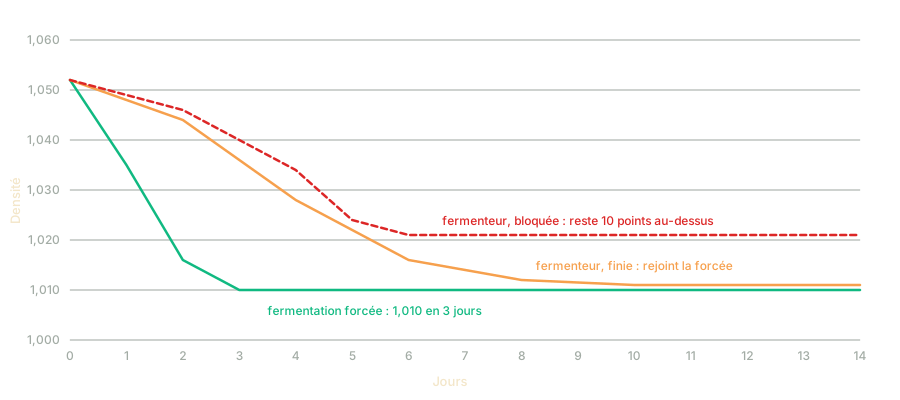
Why a fermentation gets stuck
| Cause | Clue | Restart |
|---|---|---|
| Too little yeast, or tired yeast | One sachet on 1.070, expired yeast, slow start | Add fresh yeast, rehydrated and preferably already active (a small starter in full activity, poured into the fermenter) |
| Too cold | Fermenter dropped below 16 °C (ale) or 8 °C (lager); often at night, or a Belgian yeast that falls asleep when the temperature drops | Raise by 2 to 4 °C, stir gently to put the yeast back in suspension |
| Lack of oxygen at the start | Very dense wort, liquid yeast without a starter, no aeration | Add fresh yeast; do not aerate a beer that has already fermented (oxidation) |
| Lack of nutrients | Wort with a lot of sugar or extract, little malt; mead, cider | Yeast nutrient (half a teaspoon for 20 L) with the fresh yeast |
| Yeast flocculated too early | Very flocculent English strains; compact sediment, clear beer, high gravity | Stir gently, raise the temperature |
| Alcohol above tolerance | Beer above 9 % with an average yeast | Tolerant yeast (champagne, strong strain) as an active starter |
| Fermentation genuinely finished | The forced fermentation stops at the same point | None: see below |
The most reliable restart: a one-litre starter of the same yeast or of a neutral strain, in full fermentation (krausen), poured into the beer brought back up to 20-22 °C. Dry yeast thrown as is into an alcoholic beer often dies before it has done any work.
If the fermentation is finished but too high
- Accept it: a beer that finishes at 1.018 instead of 1.012 has 0.8 % less alcohol and more body; it is often good. Check the alcohol calculation with the hydrometer tool and adjust the priming as usual.
- Add an enzyme (amyloglucosidase, sold for brut IPAs) that cuts up the dextrins: the beer finishes very dry, sometimes too dry, and you must wait for the end of its action before bottling.
- For the next batch: mash 2 °C lower, check the thermometer in boiling water and in melting ice (a 3 °C error is commonplace), reduce the caramel malts, choose a more attenuative yeast. A liquid malt extract always finishes higher than an all-grain wort: it is the number one cause among extract brewers.
The measurement trap
- The refractometer lies in the presence of alcohol: a reading of 1.020 after fermentation may correspond to 1.010. Use the alcohol with a refractometer tool, which corrects, or a hydrometer.
- A hydrometer read in a beer at 24 °C gives one point too many; in a beer at 10 °C, one point too few (gravity correction). Bubbles stuck to the hydrometer make it float higher.
- A hydrometer calibrated at 20 °C that reads 1.002 in tap water at 20 °C is off by 2 points everywhere.
Do not bottle
As long as you do not know whether the fermentation is finished, the beer stays in the fermenter. A fermentation stuck at 1.020 that restarts in the bottle, because the bottles are in the warm and the yeast wakes up, produces enough gas to exceed 5 or 6 volumes: the bottle bursts. With a gravity stable over three days and a forced fermentation that confirms it, you bottle, and dose the sugar as usual.
In the app
What Krausi does
The recipe estimates the final gravity from the yeast's attenuation, and the batch shows the last gravity reading with the current attenuation and alcohol: you can see at a glance whether fermentation stops above the estimate. Krausi refuses to record a gravity that rises without explanation, or a final gravity higher than the original one.
Frequently asked questions
My gravity is stuck at 1.020, what should I do?
Measure three days in a row, check the temperature and the hydrometer, run a forced fermentation on a sample. If the sample goes lower, restart with an active starter at 20-22 °C; otherwise the beer is finished.
How long should I wait before calling a fermentation stuck?
An identical gravity over three days, at the right temperature, after at least a week of fermentation. Before that, it is just slow.
Can I add yeast to a stuck fermentation?
Yes, but in active form: a starter in full fermentation, or a dry yeast rehydrated and gradually acclimatised with a little beer. Thrown dry into alcohol, it dies.
What final gravity is normal?
1.008 to 1.016 for most beers; the list of styles gives each one's range. An apparent attenuation of 70 to 80 % is common.
Can you bottle a beer at 1.020?
Only if a forced fermentation proves that this is its final gravity. Otherwise, the risk is the exploding bottle.
Other articles
Ready for your next brew?
Create your account, describe your first recipe to Krausi, and let him do the maths.