
All about beer
Brewing with a kveik: hot, fast, with no temperature control
Kveik (pronounced "kvike") are the farmhouse yeasts of western Norway, handed down from generation to generation, dried on wooden rings or linen and woken up at each brew. Rediscovered by home brewers in the 2010s, they have a property brewing yeasts do not: they ferment at 30, 35, sometimes 40 °C, in two or three days, without giving the fusel alcohols and solvents that a classic yeast would produce at that temperature. For a home brewer without temperature control, it is a summer yeast; for anyone who wants a beer ready in a week, a back-up yeast; for everyone, a family of strains with a character of their own, from the orange of Voss to the tropical fruit of Hornindal.
Updated on 23 October 2026
What makes them special
- Temperature: 25 to 40 °C depending on the strain, with an optimum often at 30-35 °C. Below 20 °C they fall asleep. A room at 28 °C in August, a fermenter in a cool box with a hot-water bottle, or simply wort pitched at 35 °C that cools slowly: anything will do.
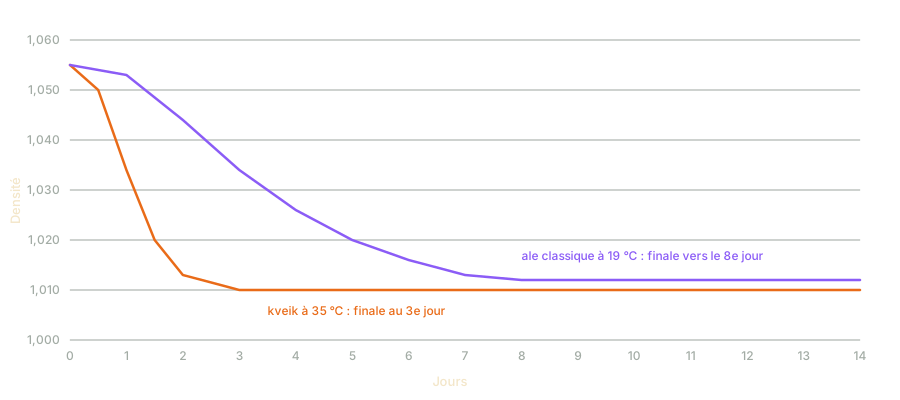
- Speed: primary fermentation in 48 to 72 hours; a beer can be bottled on the sixth day and drunk in the third week.
- Cleanness: when hot, few fusel alcohols and heavy esters; the profile is fruity (orange, mandarin, tropical fruit) and clean. Some strains are almost neutral and imitate a lager at 30 °C.
- Flocculation: most flocculate very strongly and give a brilliant beer within a few days; a few (Hornindal) stay in suspension for a long time.
- Alcohol tolerance: 12 to 16 % for several strains.
- Low dose: traditionally, Norwegian brewers pitch very little yeast (a tenth of a classic dose), which accentuates the fruitiness. With a normal dose, the profile is cleaner.
- Hunger for nutrients: they need more nitrogen than classic yeasts; without nutrient, they slow down towards the end and can leave sulphur.
The common strains
| Strain (origin) | Temperature | Profile | Flocculation | Beers that suit it |
|---|---|---|---|---|
| Voss (Sigmund Gjernes) | 25 to 40 °C, optimum 35-40 | Orange, mandarin, clean | Very high | Pale ale, IPA, blonde, farmhouse beers; the easiest to start with |
| Hornindal | 25 to 35 °C | Tropical fruit, mango, pineapple, sometimes a farmhouse background | Medium, lasting haze | NEIPA, Hazy IPA, fruity beers |
| Ebbegarden | 25 to 35 °C | Tropical fruit, pineapple, mango | Medium | IPA, pale ale |
| Lutra (selected from Voss) | 20 to 35 °C | Very neutral, "pseudo-lager" | High | Pils, helles, clean beers without cold |
| Oslo | 20 to 35 °C | Neutral, lager | High | Lagers at room temperature |
| Hothead, Stranda, Framgarden… | variable | Fruity to spicy depending on the strain | variable | Try on a pale ale to get to know the strain |
The strains are sold dry or liquid by the usual yeast labs, sometimes under a trade name; the ingredient equivalences link the trade name to the original strain.
How to brew with them
- Recipe: kveik like rich worts; a pale ale or an IPA of 1.050 to 1.065 is a good start. Fruity hops (Citra, Mosaic) pair with the orange of Voss. A pils with Lutra is the neutrality test.
- Nutrients: half a teaspoon of yeast nutrient for 20 litres, in the last 10 minutes of the boil. This is not optional.
- Chill the wort to 30-35 °C only, which is quick and saves water; pitch.
- Dose: one 11 g sachet of dry yeast for 20 litres, or half for a fruitier profile; for liquid, one pack without a starter. The yeast pitching rate tool gives the classic dose, which you can divide by 2 to 4 for a kveik.
- Ferment at 30-38 °C depending on the strain. Hold the temperature: a kveik that cools below 20 °C during fermentation stops and leaves a high gravity. In winter, a cool box with a hot-water bottle or a heating belt; in summer, nothing.
- Measure the gravity on the third day: the final gravity is often reached. Leave two more days in the warm for the yeast to finish and clean up.
- Dry hop if planned; in the warm it is very fast (2 days are enough, see dry hopping).
- Bottle as usual; refermentation at 20 °C works, and at 30 °C it takes a week.
Reusing and keeping the yeast
It is the tradition, and it works: harvest the krausen (the foam of the second day, the richest in healthy yeast) or the sediment at the end of fermentation, keep it in a sanitised jar in the fridge for several months, and repitch with a tablespoon for 20 litres. Kveik also withstand drying: spread a thin layer of sediment on baking paper, dry at room temperature for two or three days away from dust, store dry and cool; they wake up months later. It takes impeccable hygiene, and a culture must be abandoned as soon as a beer has an unexplained fault.
The limits
- The profile is not that of an English or Belgian yeast: no kveik for a typical bitter or a classic tripel, even if the result can be good.
- Underpitched and underfed, a kveik leaves sulphur and a high gravity.
- A fermentation at 38 °C gives off a lot of CO2 and can overflow: leave 25 % headspace.
- Very hoppy beers fermented at 35 °C lose more hop aroma during fermentation; the dry hop is done afterwards.
- Speed does not excuse you from waiting for a stable gravity before bottling.
In the app
What Krausi does
The app's ingredient catalogue puts kveiks in a family of their own, with their temperature range and attenuation when the sheet gives them, and Krausi finds equivalents from one strain to another. It does not set a fermentation schedule: you ask it to put the reminders you want in the calendar (end of fermentation, dry hop), and the pitching rate tool gives the classic dose, which the kveik tradition readily divides.
Frequently asked questions
What is a kveik yeast?
A family of Norwegian farmhouse yeasts that ferment at 30-40 °C in two or three days without producing off-flavours, traditionally handed down from brew to brew.
At what temperature should a kveik ferment?
30 to 38 °C for most strains; 20 to 30 °C for neutral strains such as Lutra or Oslo. Never below 20 °C during fermentation.
How long does a kveik fermentation last?
2 to 3 days for the bulk of it, 5 days to be sure. The beer is drinkable in three weeks, bottle conditioning included.
Do you need a starter for a kveik?
No. One sachet, or less, is enough for 20 litres; the tradition is to underpitch. The nutrient, on the other hand, is essential.
Can you reuse a kveik?
Yes, that is what it is for: harvest the sediment or the krausen, keep it cold or dry it, and repitch. Several dozen generations are common.
Other articles
Ready for your next brew?
Create your account, describe your first recipe to Krausi, and let him do the maths.