
All about beer
Brewing water: should you treat tap water?
Beer is 90 to 95 % water, and tap water makes very good beers in most French towns, on one condition: remove the chlorine. Everything else, salts, acids, profiles of famous cities, comes afterwards, and only once brewing and fermentation are under control. This page gives the order of priorities, explains what each ion does, teaches you to read a water report and says where to do the calculations: for salts and pH, the reference site in French is Mon Eau de Brassage, free, which Krausi refers you to.
Updated on 23 October 2026
In order: what matters
- Chlorine and chloramine. Always. They give chlorophenols, a taste of sticking plaster or swimming pool, at tiny doses. One potassium metabisulphite tablet (Campden) for 40 to 80 litres, dissolved in the water before mashing, neutralises both within a few minutes; an activated carbon filter works too; boiling or letting it stand only removes chlorine, not chloramine.
- The mash pH, between 5.2 and 5.6 measured at 20 °C. It depends on the water's alkalinity and on the colour of the malts. Outside this range: lower efficiency, astringency, harsh bitterness, darkening colour. It is the only water adjustment that really changes the efficiency.
- Calcium, between 50 and 150 mg/L. It helps the enzymes, yeast flocculation, clarification and stability. Many French waters have enough; very soft waters (Brittany, Massif Central, Vosges) do not.
- The sulphate/chloride balance, which steers perception: sulphate makes the bitterness dry and crisp, chloride rounds off the malt. It is a style adjustment, not a correction.
- The rest (sodium, magnesium, historical profiles) only has an effect at the extremes.
Reading a water report
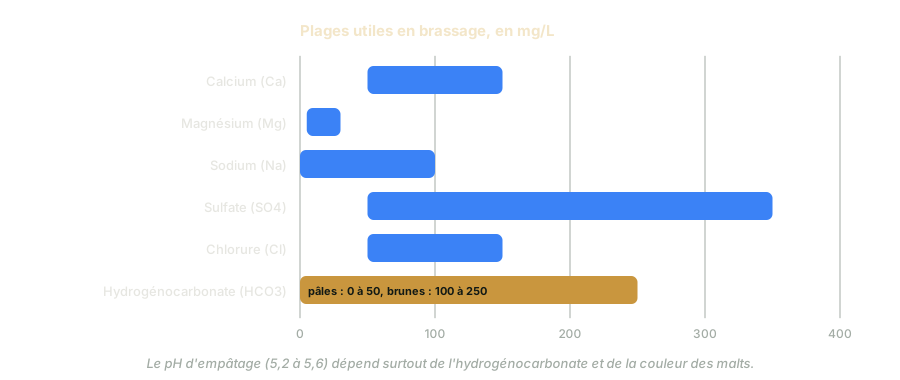
The water report of your commune is public (website of the French Ministry of Health, or geo.api.gouv.fr to find the commune: the app looks it up from the commune's name). The lines that matter, in mg/L:
| Ion | Useful range in brewing | Effect |
|---|---|---|
| Calcium (Ca) | 50 to 150 | Enzymes, flocculation, clarity, lowers the mash pH |
| Magnesium (Mg) | 5 to 30 | Yeast nutrient; bitter and laxative above 50 |
| Sodium (Na) | 0 to 100 | Roundness at a small dose; salty above 150 |
| Sulphate (SO4) | 50 to 350 | Dry, crisp bitterness; very high in English-style IPAs (Burton) |
| Chloride (Cl) | 50 to 150 | Roundness, fullness of the malt; above 200 with a lot of sulphate, a mineral taste |
| Bicarbonate (HCO3), or alkalinity, or TAC | 0 to 50 for pale beers, 100 to 250 for brown and black ones | Raises the mash pH; dark malts, being acidic, compensate for it |
Reading traps: the report sometimes gives the TAC in French degrees (1 °f = 12.2 mg/L of HCO3); the "titre hydrotimétrique" (TH, hardness) combines calcium and magnesium in French degrees (1 °f = 4 mg/L of Ca, or 2.4 of Mg); nitrates have no effect on beer below drinking-water standards. A report dated more than a year ago may have changed if the commune has changed its source.
Mash pH and residual alkalinity
Pale malt brings the pH of a water with no alkalinity to 5.7 to 5.8; a little extra acidity is needed to get down to 5.4. Caramel and roasted malts are acidic and do the job on their own: a stout mashes well in alkaline water, a pils does not. Residual alkalinity (Kolbach) sums up this balance between what raises the pH (alkalinity) and what lowers it (calcium, magnesium): the residual alkalinity tool calculates it and indicates the range of beer colour that suits it. For a complete calculation, predicted mash pH and salts to add from the list of malts and the water report, Mon Eau de Brassage does everything on one page. To correct the alkalinity:
- Too much alkalinity for a pale beer: 80 % lactic acid or phosphoric acid (the acid dose tool gives the volume for a given alkalinity and water volume; as a guide, 1 ml of 80 % lactic acid neutralises about 10 mg/L of alkalinity in 10 litres), or acidulated malt at 2-3 %, or dilution with reverse-osmosis or demineralised water (the dilution tool).
- Not enough alkalinity for a black beer: a little bicarbonate of soda or chalk, or keep the roasted malts for the end of the mash.
- Measure: a calibrated pH meter, or brewing test strips, 10 to 15 minutes after the start of the mash, on a sample cooled to 20 °C.
Salts: what one gram changes
Added to the mash water (and to the sparge water pro rata), the two useful salts:
| Salt | 1 g in 10 L brings | Use |
|---|---|---|
| Calcium sulphate (gypsum) | 23 mg/L of calcium, 56 mg/L of sulphate | Hoppy beers, crisp bitterness; raising calcium |
| Calcium chloride | 27 mg/L of calcium, 48 mg/L of chloride | Malty beers, roundness; raising calcium without drying |
| Magnesium sulphate (Epsom salt) | 10 mg/L of magnesium, 39 mg/L of sulphate | Rarely useful, only if Mg is very low |
| Sodium chloride (non-iodised salt) | 39 mg/L of sodium, 61 mg/L of chloride | Roundness at a very small dose; gose |
The sulphate/chloride ratio (the ratio tool) serves as a guide: around 0.5 for a malty beer or a NEIPA, 1 for balance, 2 to 3 for a pale ale or a West Coast IPA. Above 300 mg/L of sulphate or 150 of chloride, you can taste the water. The salt additions tool calculates the grams to go from one profile to another; Mon Eau de Brassage does it taking the malts and the pH into account at the same time.
Bottled, reverse-osmosis, softened water
- Dechlorinated tap water: the default choice, free, often well mineralised, and waste-free.
- Bottled spring water: in our view, not a solution. A 20-litre batch needs 25 to 30 litres of water, i.e. some twenty 1.5-litre bottles to carry, then as much plastic to throw away, for a water often almost without calcium that has to be topped up with salts anyway. The price counts, but the plastic waste counts more: a Campden tablet and, if needed, a few grams of salts do better starting from tap water. There remains the case of mains water that is genuinely unsuitable (very alkaline, or with a marked taste despite dechlorination): the reverse-osmosis water below is then preferable to bottles.
- Reverse-osmosis or demineralised water: a blank page, to be rebuilt entirely with salts; mostly useful for diluting water that is too alkaline.
- Water softened by a domestic softener: avoid. The softener replaces calcium with sodium; the water loses what is useful and gains what is not.
In what order to get started
First batch: dechlorinate. Tenth batch: measure the mash pH and correct it if needed. Only then: play with sulphate and chloride for a style, and compare two batches of the same recipe. Changing the water on a batch where efficiency, fermentation and hygiene are not yet stable does not let you know what made the difference.
In the app
What Krausi does
Krausi calculates neither salts nor pH, and is not meant to: Mon Eau de Brassage does it very well, in French, with commercial malts and acids. The app keeps the brewer's water profile (commune, or ions entered); each recipe opens the calculation on Mon Eau de Brassage in one click, pre-filled with the malts, the volume and the style, then imports the result (salts and acid as adjuncts of the recipe). Krausi refers you to that calculation; treating the chlorine remains the brewer's own action, to be done in the water before mashing. The site's tools (residual alkalinity, acid dose, sulphate/chloride ratio, salt additions, dilution) cover each step separately.
Frequently asked questions
Should you brew with bottled water?
No. Twenty plastic bottles per batch for a water almost without calcium: dechlorinated tap water does better, and genuinely unsuitable water is corrected by dilution with reverse-osmosis water.
Can you brew with tap water?
Yes, almost everywhere, by removing the chlorine with a Campden tablet or a carbon filter.
How do you remove chlorine from water for brewing?
One potassium metabisulphite tablet for 40 to 80 litres, or an activated carbon filter. Letting it stand or boiling does not remove chloramine.
What pH for the mash?
5.2 to 5.6, measured on a sample at 20 °C. Pale beers need low-alkalinity water or a little acid, brown beers tolerate alkalinity.
Should you add salts?
If calcium is below 50 mg/L, yes, a little gypsum or calcium chloride. Otherwise, only to steer a style, once the rest is under control.
What water for an IPA, what water for a stout?
IPA: calcium 100 to 150, sulphate 200 to 300, chloride 50 to 100, low alkalinity. Stout: alkalinity 100 to 200, chloride rather than sulphate. The NEIPA inverts the IPA: chloride 150 to 200, sulphate 50 to 100.
Other articles
Ready for your next brew?
Create your account, describe your first recipe to Krausi, and let him do the maths.