
All about beer
Getting your dry hop right
Dry hopping consists of adding hops to the beer after the boil, in the fermenter, to extract their aromas without extracting bitterness: cold, the alpha acids do not isomerise. It is the technique that makes modern IPAs, and the one where home brewers lose the most aroma for three reasons: too little hops, too long, and air getting in. This guide gives the figures to go by.
Updated on 23 October 2026
How much hops
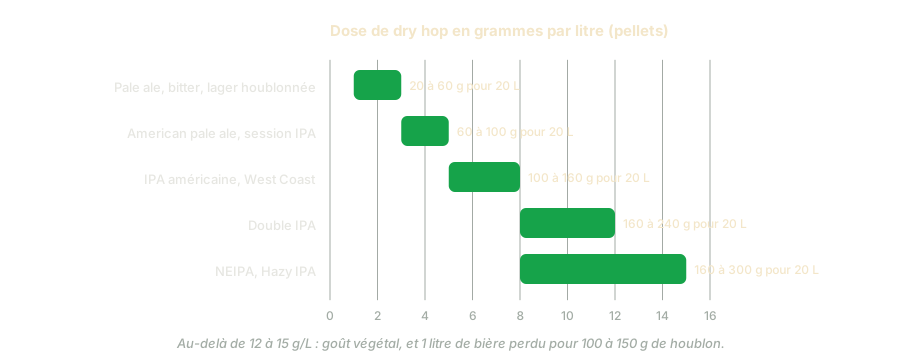
The dose is expressed in grams per litre of beer. The guidelines below match the common practice of craft breweries for pellets; whole cones need 20 to 30 % more for the same effect.
| Style | Dry hop dose | For 20 litres |
|---|---|---|
| Pale ale, bitter, hoppy lager | 1 to 3 g/L | 20 to 60 g |
| American pale ale, session IPA | 3 to 5 g/L | 60 to 100 g |
| American IPA, West Coast | 5 to 8 g/L | 100 to 160 g |
| NEIPA, Hazy IPA | 8 to 15 g/L | 160 to 300 g |
| Double IPA | 8 to 12 g/L | 160 to 240 g |
Above 12 to 15 g/L, the aroma no longer increases proportionally, the beer takes on a vegetal, grassy taste, and you lose a lot of volume in the soaked hops: count 1 litre of beer absorbed per 100 to 150 g of pellets. A 300 g dry hop in 20 litres leaves 17 to 18 litres to bottle, which the number of bottles tool takes into account with the losses.
Which hops
The so-called aroma hops, rich in essential oils (more than 1.5 ml per 100 g): Citra, Mosaic, Simcoe, Amarillo, Cascade, Centennial for American citrus and tropical fruit; Nelson Sauvin, Motueka for New Zealand; Galaxy for Australia; Saaz, Hallertau Mittelfrüh, Styrian Goldings for European herbal and floral notes. The alpha acid content does not matter at all in dry hopping, since they do not isomerise; what counts is freshness: a hop from this year's harvest, kept vacuum-packed in the freezer. A packet open for six months at room temperature has lost most of it. To replace a hop that is out of stock, the hop substitution tool and the ingredient equivalences list the close profiles.
When: during or after fermentation
Three possible moments, which give different beers.
- After fermentation, final gravity reached: the general case. The aromas are not carried off by the CO2 of fermentation, the result is predictable, and you control the duration. It is the method to go for on a first dry hop.
- During active fermentation, around two thirds of the way (for example at 1.020 for an IPA that finishes at 1.012): the yeast transforms some hop compounds (biotransformation), which gives the tropical and stone fruit notes typical of NEIPAs. The escaping CO2 protects from oxygen. In return, part of the aromas leaves with the gas, and the hops restart fermentation: see hop creep below.
- In two goes, one during, the other after: the common practice for NEIPAs, with half the dose each time.
How long
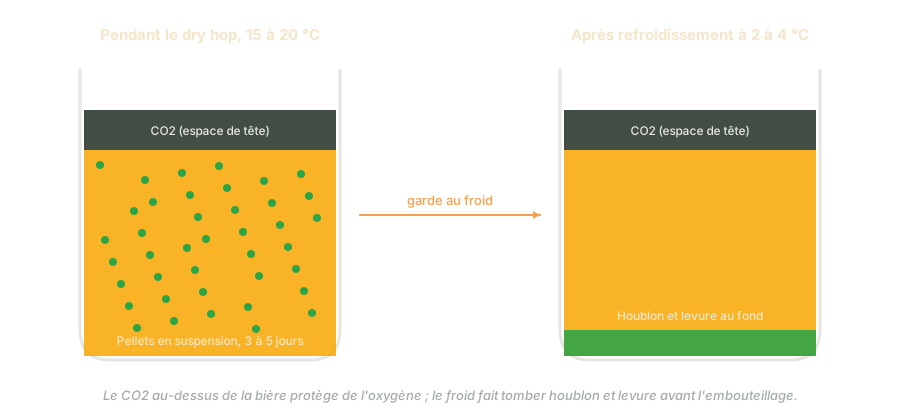
Extraction of the aromatic oils is fast: most of it is extracted within 24 to 48 hours with pellets, which break up in the beer. Beyond 5 to 7 days, the aromas no longer increase and the vegetal compounds (chlorophyll, polyphenols) keep passing into the beer: cut-grass taste, astringency. The 10 to 14 days once read about date from whole cones and open fermenters. Guideline: 3 to 5 days. If the beer has to wait before bottling, better to delay adding the hops than to let them soak.
At what temperature
Between 15 and 20 °C, extraction is good and fast. Cold, below 10 °C, it is much slower and more selective: some breweries dry hop cold for cleaner aromas, but you then have to count a week or more. For the home brewer: dry hop at the end-of-fermentation temperature, then chill the beer if you can (cold conditioning), which drops the hops and the yeast to the bottom and clarifies before bottling.
How: limiting oxygen
Oxygen is the worst enemy of a hoppy beer: it turns fruit aromas into cardboard within a few weeks (see oxidation in off-flavours). Every opening of the fermenter lets air in. A few practices within reach without special equipment:
- Prepare everything before opening: hops weighed, bag or mesh sanitised if you use one. Open, pour, close again in under a minute.
- Add the hops while fermentation is still producing a little CO2 (around 1.015 to 1.020 for a beer that finishes at 1.012), which drives out the air that got in.
- Loose pellets extract better than in a bag, where they pack together; the bag makes racking easier. With a bag, fill it half full at most and weigh it down.
- Never stir or open "to have a look".
- Bottle or keg as soon as the dry hop is over, and drink within two months.
Hop creep: the fermentation that restarts
Hops contain enzymes that cut up unfermentable sugars left in the beer into sugars the yeast can consume. After a big dry hop, the gravity can drop by a further 2 to 4 points over several days, and the yeast, woken up, produces diacetyl. Consequences if you bottle too early: over-gassy bottles, or even bursting ones, and a butter taste. Precautions: measure the gravity after the dry hop and wait for it to be stable two days in a row before priming; keep the beer at 18-20 °C during the dry hop so that the yeast cleans up the diacetyl; slightly reduce the priming dose calculated by the priming sugar tool if the gravity was still moving the day before.
The dry hop in the batch sheet
Note the date, the dose, the hop and its harvest, the temperature and the gravity before and after: that is what lets you know, at tasting, whether the aroma was lacking because the hops were old, the dose too low or the time too long. In the app, Krausi plans the dry hop from the recipe (the duration field of a dry hop is in days), adds the addition and removal reminders to the calendar, and by e-mail; the gravities noted in the batch log show any hop creep.
Common mistakes
- 30 g in 20 litres "to see": at 1.5 g/L you smell nothing in an IPA. Go up to at least 5 g/L.
- A hop opened a year ago: smell of cheese and hay.
- Two weeks of contact: grass and astringency.
- Opening the fermenter three times: cardboard after a month.
- Bottling the day after the dry hop without measuring again: over-carbonated bottles.
- Dry hopping a beer hazy with yeast, before any settling: the yeast carries part of the aromas to the bottom.
Frequently asked questions
How much hops for a 20-litre dry hop?
60 to 100 g for a pale ale, 100 to 160 g for an IPA, 160 to 300 g for a NEIPA, in pellets.
How many days does a dry hop last?
3 to 5 days at 15-20 °C. Beyond a week, the beer takes on a grassy taste.
Does dry hopping add bitterness?
Almost no IBU, the alpha acids do not isomerise cold. But a very big dry hop gives a perceived, vegetal bitterness that does not appear in the calculation.
Should you sanitise the hops?
No. Hops are naturally antiseptic and adding them to an alcoholic beer poses no hygiene problem. On the other hand, everything used to add them (bag, funnel, hands) must be sanitised.
Can you dry hop in the bottle?
One or two cones per bottle is done, but the result is uneven and the hops stay in the served beer. The fermenter remains the right method.
Other articles
Ready for your next brew?
Create your account, describe your first recipe to Krausi, and let him do the maths.