
All about beer
Off-flavours in beer: recognising and correcting them
An off-flavour is an aroma or a taste that has no business in the style being brewed: butter in a pils, green apple in a pale ale, cardboard in an IPA. Each has a known chemical origin, a step of brewing where it appears and, most often, a simple correction. This guide gives the complete table of the twelve faults home brewers meet, then the detail of each. To learn to detect them in the glass, the article How to taste beer explains the method; here we look for the cause.
Updated on 23 October 2026
The table of faults
| What you perceive | Name | Molecule | Step responsible | Most frequent cause for the home brewer | Correction |
|---|---|---|---|---|---|
| Butter, butterscotch, popcorn, slick mouthfeel | Diacetyl | 2,3-butanedione | Fermentation | Beer racked or chilled too early, yeast removed before the end; Pediococcus infection | Leave 2 to 3 more days at 18-20 °C at the end of fermentation (diacetyl rest) |
| Green apple, fresh pumpkin, latex paint | Acetaldehyde | Ethanal | Fermentation, conditioning | Beer too young, stressed fermentation (tired yeast, too little yeast), oxidation | Wait, pitch enough, let the yeast finish |
| Wet cardboard, paper, sherry, old honey; hops that vanish | Oxidation | Trans-2-nonenal and other aldehydes | Transfers, bottling, storage | Air sucked in at racking, headspace, dry hop with air getting in, bottles kept warm | Transfer without splashing, purge with CO2 if possible, store cool, drink hoppy beers young |
| Cooked corn, cabbage, boiled vegetables | DMS | Dimethyl sulphide | Boil, chilling | Boil too weak or covered, slow chilling, very pale malts (pilsner) | A vigorous boil with no lid for 60 to 90 min, chill fast |
| Clove, medicine, plastic, sticking plaster | Phenolic | 4-vinylguaiacol, chlorophenols | Water, yeast, hygiene | Chlorine from tap water (chlorophenols), wheat or Belgian yeast out of style, wild yeast | Filtered water or water treated with metabisulphite, suitable yeast, hygiene |
| Varnish, nail-varnish remover, burning alcohol, headache | Solvent | Higher alcohols, ethyl acetate | Fermentation | Fermentation too warm in the first days, underpitching, very dense wort | Hold the style's temperature for the first 3 days, pitch enough |
| Sour, sharp, lactic acid or vinegar | Sour | Lactic acid, acetic acid | Hygiene | Contamination by lactic or acetic bacteria (scratched fermenter, tap, tubing) | Sanitise everything that touches the cooled wort, replace scratched plastic |
| Dry, rough mouth, tannins, over-brewed tea | Astringency | Polyphenols | Mash, sparge | Sparging too hot (above 78 °C) or too far, sparge pH too high, grain milled too fine, squeezing the bag | Sparge at 75-78 °C, stop when the runnings drop below 1.010, watch the pH |
| Coins, blood, ink | Metallic | Iron, copper ions | Water, equipment | Iron-rich water, new unpassivated equipment, rusty caps | Analyse the water, use clean stainless steel, new caps |
| Skunk, burnt rubber, "lightstruck" | Light | 3-methyl-2-butene-1-thiol | Storage, serving | Clear or green bottles exposed to light, even a few minutes in the sun | Brown bottles, storage in the dark |
| Struck match, rotten egg, sewer water | Sulphur | H2S, SO2 | Fermentation | Normal in a lager during fermentation; stressed yeast; sometimes water | Wait, the yeast reabsorbs it; let the cold conditioning finish |
| Broth, yeast, meat, excess umami | Yeast (autolysis) | Yeast lysis products | Storage | Beer left for months on a thick yeast deposit in the warm | Rack after 3 to 4 weeks if conditioning goes on, store cool |
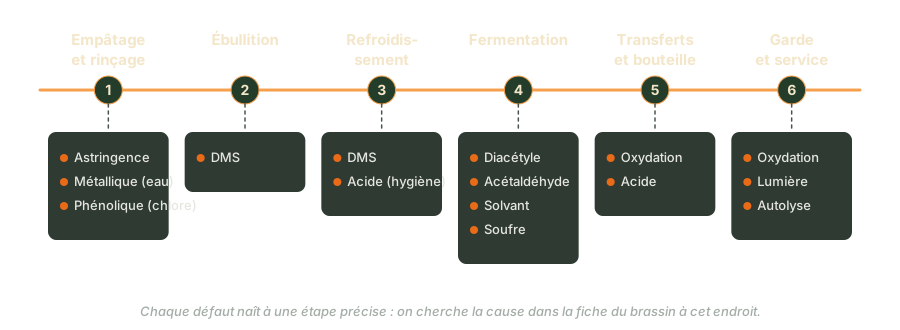
The method for finding the cause
- Taste the beer at several moments: at racking, at bottling, after two weeks, after two months. A fault present from the fermenter comes from brewing or fermentation; a fault that appears during storage comes from bottling or storage.
- Taste several bottles: a fault in a single bottle is a bottle problem (badly rinsed, badly capped), not a batch problem.
- Reread the batch sheet: fermentation temperature day by day, racking date, final gravity. Most fermentation faults can be read in those three pieces of data.
- Compare with the style: clove is a fault in a pils and a quality in a weizen; sulphur is normal in a young lager.
- Correct only one thing at a time at the next batch, otherwise you will not know what worked.
Fermentation faults
Diacetyl: butter
The yeast produces a precursor of diacetyl at the start of fermentation, then reabsorbs it at the end, provided it is still active and in suspension. If you chill, rack or bottle before that phase, the butter stays. For the home brewer, the number one cause is impatience: the gravity seems stable, you rack, and the yeast has not had its two or three days of clean-up. A diacetyl rest is simply leaving the fermenter 2 to 3 days at 18-20 °C once the final gravity is reached, including for a lager that you bring up in temperature. The forced heating test lets you check: a covered sample, heated for 20 minutes at 60 °C then cooled, reveals the hidden diacetyl that cold beer masks. A diacetyl that increases over time in the bottle, with sourness, points instead to a Pediococcus contamination.
Acetaldehyde: green apple
It is the step just before alcohol in the yeast's work. A young beer always holds a little; a healthy yeast turns it into ethanol in the last days. You find it when fermentation was stressed: too little yeast, wort too dense for the amount pitched, yeast removed too early, or oxidation that re-forms it from the alcohol. Correction: patience first, then the amount of yeast, which the pitching rate tool calculates from gravity and volume.
Solvent and fusel alcohols
Higher alcohols and heavy esters (ethyl acetate, smell of nail-varnish remover) come from a fermentation that is too warm during the growth phase, the first three days. An ale fermented at 24 °C in the kitchen, when fermentation itself heats the wort by a further 2 to 3 °C, gives a beer that stings the nose and the head. The temperature that counts is the wort's, not the room's. Underpitching makes it worse, because the yeast multiplies more.
Sulphur
Egg or struck match during the fermentation of a lager is normal: bottom-fermenting yeasts produce hydrogen sulphide, which the CO2 drives off and which cold conditioning finishes erasing. In an ale, marked sulphur indicates a stressed yeast (lack of nutrients, zinc, temperature) or sulphate-rich water with certain strains. You wait before worrying.
Boil and chilling faults
DMS: cooked corn
Pale malt contains a precursor (SMM) that heat turns into DMS, which evaporates with the steam. So you need a vigorous boil, with no lid, long enough (60 minutes at least, 90 for a very pale beer based on pilsner malt), then fast chilling: as long as the wort is above 80 °C without boiling, DMS forms and no longer evaporates. A lid put on to limit evaporation, or an hour and a half of chilling, are enough to give cooked corn. The boil-off rate tool helps plan the starting volume without covering.
Astringency
The tannins of the grain husk pass into the wort when sparging is too hot, too long or at too high a pH (above 6). The signs: a mouth that dries out, a rough feeling after the sip, distinct from bitterness. With three vessels, you stop sparging when the last runnings drop below 1.010 gravity; in BIAB, you avoid wringing the bag while hot. Milling too fine, which tears the husks, and an overdose of vegetal hops in the dry hop give the same effect.
Hygiene, water and equipment faults
Sour: contamination
A beer that turns sour, sometimes with a white film on the surface of the fermenter and carbonation that increases in the bottle, is contaminated by lactic or acetic bacteria, or by wild yeast. They get in through whatever touches the cooled wort: scratched plastic fermenter, tap never dismantled, racking tube, badly filled airlock. Boiling wort is sterile; everything happens afterwards. The correction lies entirely in sanitising, dosed with the cleaning and sanitising products tool, and in replacing scratched plastic. A sour beer is not dangerous; it is sometimes very good, but it is not the one you wanted.
Phenolic: clove, medicine
Two families. 4-vinylguaiacol, clove, comes from certain yeasts (German wheat, Belgian, wild): it is intended in a weizen and a fault elsewhere; you change strain. Chlorophenols, a taste of sticking plaster or swimming pool, arise when the chlorine or chloramine of tap water meets the phenols of the malt. One potassium metabisulphite tablet (Campden) for 40 to 80 litres of water, or a carbon filter, is enough. It is the easiest fault to eliminate for good.
Metallic
Iron or copper in the water, new stainless steel equipment never passivated, unoxidised aluminium pan, caps rusting in a damp cardboard box. A water report (the article Brewing water explains how to read it) quickly settles the question of the water.
Storage faults
Oxidation
Oxygen is welcome once only: in the cooled wort, before the yeast. Afterwards, every contact with air wears the beer down: cardboard and paper for pale beers, sherry and old honey for strong ones, quick disappearance of hop aromas in IPAs. The sources for the home brewer: a racking that splashes, a siphon that sucks in air, opening the fermenter for a dry hop, a large headspace, and bottles kept at room temperature for months. Bottles speed up the phenomenon compared with a keg, because each cap lets in a little air. Correction: transfer calmly, from the bottom, as rarely as possible; dry hop while limiting the time open; keep hoppy beers cool and drink them within two months.
Lightstruck taste
Light, especially blue and ultraviolet, breaks down the hop acids and forms within minutes a thiol that smells of skunk. Brown bottles block most of the spectrum, green and clear ones almost nothing. A crate of clear bottles in the sun for the length of an aperitif is enough. Correction: brown bottles, darkness, and never serve a hoppy beer in a glass in the sun for more than a few minutes.
Autolysis
When yeast dies, it releases its contents: taste of broth, yeast, umami. It happens when a beer spends months on a thick deposit, especially in the warm. For the home brewer it is rare below six weeks at 20 °C. If conditioning goes on, you rack into a second vessel or bottle.
In the app
What Krausi does
In the app, the tasting sheet of a batch ticks the faults perceived, each with a link to its description in the article How to taste a beer. Krausi knows the batch sheet (temperatures, dates, gravities) and can suggest the most likely cause given what was done, then note the correction to apply at the next batch in the recipe's notebook.
Frequently asked questions
My beer tastes of butter, is it lost?
Not if it is still in the fermenter: 2 to 3 more days at 18-20 °C are often enough. In the bottle, the priming yeast sometimes absorbs part of it within a few weeks, but a diacetyl that increases points to an infection.
Why does my beer smell of sulphur?
It is normal during the fermentation of a lager and for a few days with some ales. It disappears with conditioning. If it remains after a month, the yeast lacked something: temperature, nutrients, oxygen at the start.
How do I know whether my beer is infected?
Three signs together: sourness that was not there at racking, carbonation that increases week after week, and sometimes a film or strands on the surface. One of the three alone is not enough to conclude.
Can an oxidised beer be saved?
No. Oxidation is irreversible. You drink it fast if it is still pleasant, and correct the transfers for the next one.
What is the most frequent fault among beginner brewers?
Fermentation that is too warm, which gives solvent and heavy esters, followed closely by oxidation at racking and the impatience that leaves diacetyl and acetaldehyde.
Other articles
Ready for your next brew?
Create your account, describe your first recipe to Krausi, and let him do the maths.