
All about beer
Brewhouse efficiency: understanding, measuring and stabilising it
Efficiency, or yield, says what share of the sugar held in the malt ends up in the wort. A brewer who aims for a gravity of 1.050 and measures 1.042 has an efficiency problem, and will brew a lighter beer than planned, proportionally less bitter, and paler. This guide explains what efficiency measures, how to calculate it with your own batch, why it is low, and why the goal is not to maximise it but to know it.
Updated on 23 October 2026
Two efficiencies, not one
- Mash efficiency (or lauter efficiency) compares the sugars extracted at the end of sparging, in the boil kettle before boiling, with the grain's potential. It measures the quality of the mash and the sparge.
- Brewhouse efficiency compares the sugars that arrive in the fermenter with the same potential. It includes every loss: wort left in the kettle with the hops and proteins, in the tubing, in the chiller. It is the one recipe software uses to calculate the original gravity, and the one Krausi measures.
The two differ by 5 to 10 points. Saying "I get 75 %" without specifying which is the source of most misunderstandings between brewers.
The benchmarks
| Method | Usual brewhouse efficiency |
|---|---|
| Hopped kit, malt extract | Not applicable: there is no mash, the manufacturer guarantees the extract |
| BIAB, no sparge | 60 to 72 %, depending on the fineness of the crush and the squeezing of the bag |
| All-in-one system, with sparge | 70 to 80 % |
| Three vessels, fly sparge | 72 to 85 % |
| Professional brewery | 85 to 95 % |
Krausi's reference recipes assume 72 % until the set-up has been measured.
The calculation
A malt's potential is the gravity it would give if all its extract passed into the wort. It is expressed in points per kilo and per litre: a pilsner malt has an extract yield of about 80 % of its mass, i.e. 0.80 × 384 = 307 points for 1 kg in 1 litre; a caramel malt 72 to 75 %, flaked oats 70 %, sugar 100 % (384 points). A gravity of 1.050 is worth 50 points.
Formula of the brewing efficiency tool:
- Total potential = Σ (kg of each malt × malt yield × 384)
- Points obtained = (measured gravity − 1) × 1000 × measured volume in litres
- Efficiency = points obtained / total potential × 100
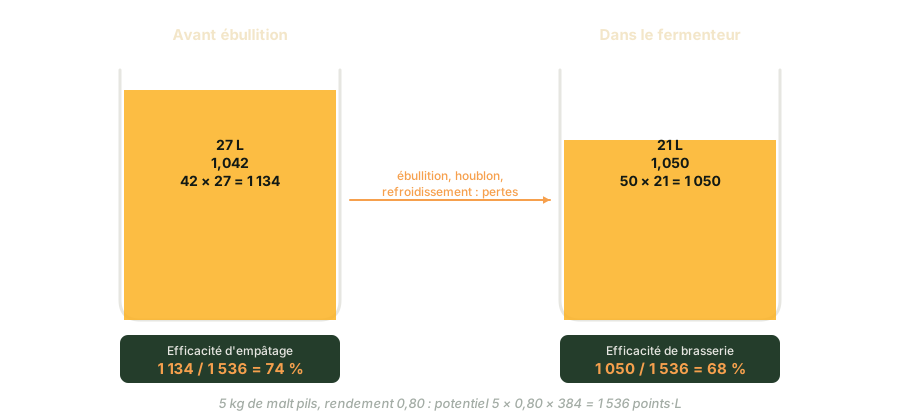
Example: 5 kg of pilsner malt (yield 0.80). Potential = 5 × 0.80 × 384 = 1,536 points·L. In the fermenter, 21 litres at 1.050: 50 × 21 = 1,050 points·L. Brewhouse efficiency = 1,050 / 1,536 = 68 %. Before the boil, 27 litres at 1.042: 42 × 27 = 1,134; mash efficiency = 74 %. The 6-point gap is the kettle and chilling losses.
Mind the two measurements: the gravity must be corrected for temperature (the gravity correction tool; a hydrometer read at 60 °C gives a figure that is 15 points off) and the volume measured at the same moment, hot or cold, brought back to 20 °C (hot wort takes up 4 % more, volume at 20 degrees tool). An efficiency calculated with a hot gravity and a hot volume is off by several points.
Why efficiency is low
In order of frequency for the home brewer.
- The crush. It is the first cause. A grain barely split releases little starch; a crush that is too fine sticks the lauter in three vessels but suits BIAB. Buying crushed malt is convenient but the supplier's crush is often coarse; a finer crush gains 5 to 10 points, which is more than any other adjustment.
- The sparge. Without sparging (BIAB), the sugars left in the wet grain are lost: 1 kg of spent grain holds 0.8 to 1 litre of sugary wort. Sparging, or squeezing the bag, or replacing the sparge with a thinner mash recovers part of it.
- The water-to-grain ratio and the temperature. A very thick mash (less than 2.5 L/kg) converts less well; a temperature outside the 62-70 °C range slows or destroys the enzymes. The strike water temperature tool avoids missing the target.
- The pH. Outside 5.2 to 5.6, the enzymes work more slowly. Very alkaline water with pale malts gives a pH of 5.8 to 6 and fewer points (see Brewing water).
- The duration. 60 minutes are almost always enough with modern malts; below 45, conversion may be incomplete. An iodine test, a drop on a little wort that does not turn black, confirms it.
- The losses. 2 litres of kettle bottom out of 25 with the hops, a chiller that holds 1 litre: that is 10 % of brewhouse lost without the mash being to blame. Measure them once and for all and enter them in the set-up's settings.
- The malt itself. An old or badly stored malt has a reduced potential. Big loads of speciality malts, flakes or wheat lower the average yield through their lower potential, which is not a brewing fault.
Why stabilise rather than maximise
A known, constant efficiency of 65 % beats one that swings between 68 and 80: the recipe calculated with the right efficiency lands right every time, and 10 % more malt is all it takes to compensate. Conversely, pushing efficiency beyond 80 to 85 % at home is done by sparging hotter and longer, which extracts tannins (astringency) and raises the pH of the last runnings. Large breweries manage it with filters and controls the home brewer does not have. For a 20-litre batch, 500 g more malt costs less than an astringent beer.
The rule: measure the efficiency over three batches, take the average, enter it in the settings, and change it only if the crush or the method changes.
Rescuing a batch
If the pre-boil gravity is below target, you can, in order: lengthen the boil to concentrate (10 % more evaporation gives about 4 points on 1.045), add sugar or dry malt extract (100 g of DME in 20 L gives about 1.7 points), or accept a lighter beer and reduce the hops to keep the BU:GU ratio. The adjust the wort gravity tool calculates the amount of water or sugar. If the gravity is above, you dilute with boiled water.
In the app
What Krausi does
The app calculates the brewhouse efficiency of each batch from the measured gravity and volume, then the average of the last ten batches becomes the measured efficiency of the set-up. When Krausi proposes a recipe, it uses this value rather than the reference recipe's (72 % most often), and it says where the figure comes from.
Frequently asked questions
What efficiency for a 20-litre BIAB batch?
60 to 72 % brewhouse without sparging. Squeezing the bag or rinsing it with 2 to 4 litres of water at 75 °C gains 3 to 6 points.
How do you calculate your efficiency?
Measured gravity points × litres, divided by the sum of kilos of malt × yield × 384. The brewing efficiency tool does it from the list of malts and the measured gravity.
My efficiency is 55 %, what should I do?
The crush first, finer. Then check the real mash temperature with a thermometer tested in boiling water, and the pH. Do not try to sparge hotter.
Should you aim for 80 %?
No. A known efficiency is enough; above 80 %, the risk of astringency increases for a gain of 300 g of malt.
Does efficiency change with the beer's gravity?
Yes: a strong beer (above 1.070) has an efficiency 5 to 10 points lower, because the larger grain bill holds more wort and the sparge is limited by the vessel's volume. Software and Krausi do not correct for it automatically: plan a little more malt or some sugar.
Other articles
Ready for your next brew?
Create your account, describe your first recipe to Krausi, and let him do the maths.