
All about beer
My beer is flat, or it foams too much
Bottle carbonation relies on a refermentation: a little sugar, the yeast still present, three weeks in the warm, and the CO2 produced dissolves into the beer under the cap. When it fails, it fails one way or the other: flat bottles after a month, or bottles that overflow on opening, or even burst. Both have precise causes, almost always identifiable from the batch's sheet. The bottling guide explains how to do it; this page explains why it did not work.
Updated on 23 October 2026
The diagnosis in five questions
- How long, at what temperature? Less than two weeks, or bottles kept below 18 °C: it is too early to conclude.
- All the bottles, or some of them? A single flat bottle is a leaking cap; all flat, it is the batch.
- How much sugar, for what real volume? Check with the priming sugar tool by entering the volume actually bottled, not the recipe's.
- Was the gravity stable before bottling? If it was measured only once, fermentation may not have been finished.
- Was the beer chilled for a long time, filtered, or is it above 8 % alcohol? There may be too little active yeast left.
Flat beer
| Cause | How to tell | Remedy |
|---|---|---|
| Not enough time or too cold | Less than 3 weeks, or a cellar at 12-15 °C | Bring the bottles back up to 20-22 °C for two weeks |
| Too little sugar | Dose calculated for 20 L when 17 L were bottled, or target too low (less than 2 volumes) | Nothing to be done on this batch, except reopening and re-priming, which oxidises; recalculate next time |
| Too little active yeast | Several weeks of cold conditioning, beer above 8 %, fined with gelatine, or a lager stored for a long time | Add a pinch of dry yeast (0.5 g for 20 L, rehydrated) at priming; for this batch, gently swirl each bottle and wait in the warm |
| Leaking caps | Only a few bottles, often the same neck models; sticky ring around the cap | Check the capper's adjustment, set aside bottles with a damaged neck |
| Sugar unevenly spread | Some bottles flat, others very gassy, in the same batch | Dissolve the sugar in a little boiled water and mix it into the whole batch in a second vessel before bottling, rather than bottle by bottle |
| Yeast exhausted by a very warm or very long fermentation | Final gravity reached more than 6 weeks ago | Add fresh yeast at priming |
A beer that is flat but has gas on uncapping (a hiss) mostly lacks time or serving cold: a beer is drunk after 24 hours in the fridge, which moves the CO2 from the headspace into the liquid.
Beer that foams too much, bottles that burst
| Cause | How to tell | Remedy |
|---|---|---|
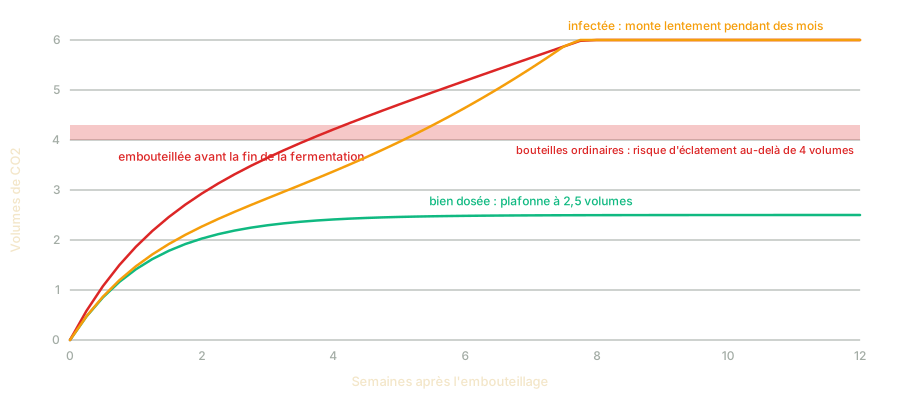
| Fermentation not finished at bottling | Gravity measured only once, or bottling on a fixed day; every bottle is affected and the gas rises week after week | Put the whole batch in the fridge right now, open over a sink, drink fast. Always wait for two identical readings three days apart |
| Hop creep after a big dry hop | Dry hop above 5 g/L, bottling in the following days, gravity dropped by 2 to 4 points (see dry hopping) | Same treatment; next time, leave a week after the dry hop at 18-20 °C and measure again |
| Too much sugar | More than 8 g/L of dextrose, or beer volume overestimated, or a 3-volume target in ordinary bottles | Refrigerate, drink. Thick beer bottles or swing-top bottles above 2.8 volumes |
| Infection | Sourness or a new taste, gas rising for months, sometimes a film or strands; often a few bottles first | Throw away what is sour if it was not intended, sanitise and replace scratched plastic (see infected beer) |
| Gushing: the beer gushes even cold and properly dosed | Immediate foam on opening, bottle after bottle, without excess gas under pressure | Causes: particles (hops, calcium oxalate, malt dust) acting as nucleation points, or malt contaminated by Fusarium in the field (rare, change malt batch). Rinse the bottles well, filter out the hops |
| Dirty or dusty bottles | Only a few bottles, normal gas for the others | Rinse with hot water as soon as a bottle is emptied, sanitise just before filling |
A bursting bottle is dangerous. As soon as a batch gasses too much, put it in the cold, in a closed crate, and open it with gloves and a towel over the sink.
The right figures
- Target: 2.2 to 2.6 volumes of CO2 for most ales, 2.5 to 3 for lagers, wheat beers and Belgians (see carbonation by style). Commercial 33 cl bottles hold 3 volumes, 75 cl corked or champagne bottles 4.
- Dose: about 6 to 7 g of dextrose per litre for 2.5 volumes from a beer at 20 °C. The beer's temperature matters, because a colder beer already holds more dissolved CO2: the priming sugar tool takes it into account, and the priming by sugar type tool converts if you use another sugar.
- Time: 2 to 3 weeks at 20-22 °C, then at least 2 days in the cold before tasting. A beer at 8 % and above may need 4 to 6 weeks.
- Yeast: enough is left in a beer racked after 2 to 4 weeks of fermentation, even a clear one; above 8 % alcohol or after a long cold conditioning, add some.
In the app
What Krausi does
In the app, the batch keeps the target carbonation, the packaged volume, the sugar added and the bottling date. Krausi refuses to record a priming dose above 4.3 volumes without explicit confirmation, and when a message gives a dangerous dose, it says so and gives the safe doses. On request, it sets a reminder to open the first bottle.
Frequently asked questions
My beer is flat after three weeks, what should I do?
Put it at 22 °C for two more weeks, gently turning each bottle over once. If nothing changes, yeast or sugar is lacking; this batch will stay flat.
Can you reopen bottles to add sugar?
Technically yes, but every opening lets air in and oxidises the beer. Keep it for the case where there really was no sugar.
Why does my beer foam as soon as it is opened when it is properly dosed?
Either it was bottled before the end of fermentation, or it is gushing: particles or contaminated malt. Check the recorded gravities first.
How much sugar for 20 litres?
About 120 to 140 g of dextrose for 2.5 volumes from 20 °C; the priming tool gives the exact value according to temperature and sugar.
Can bottles explode?
Yes, above 4 volumes for an ordinary bottle, and sooner for a scratched one. As soon as a batch is suspect, it goes in the cold.
Other articles
Ready for your next brew?
Create your account, describe your first recipe to Krausi, and let him do the maths.