
All about beer
Creating your own beer recipe
After a few batches of recipes found elsewhere, you want your own. A recipe is not a list of ingredients drawn at random: it is a target style, a gravity, a bitterness and a colour that match it, then the ingredients that lead there. This guide gives the method in six steps and runs through it on a 20-litre American pale ale. All the figures come from the formulas of the site's calculators.
Updated on 23 October 2026
Step 1: start from a style and its figures
Even for a beer you want to be original, a style gives bounds that guarantee a balanced beer: original and final gravity, bitterness, colour, alcohol. The list of styles gives them for 103 styles. For an American pale ale (18B): gravity 1.045 to 1.060, final 1.010 to 1.015, 30 to 50 IBU, 10 to 20 EBC, 4.5 to 6.2 % alcohol. You set a target within the range: 1.052, 38 IBU, 12 EBC, 5.1 %.
Step 2: volume and efficiency
The volume is what arrives in the fermenter, not the kettle's. The efficiency is your set-up's, measured (see brewhouse efficiency), or 72 % failing that. The whole recipe depends on it: the same list of malts gives 1.052 at 72 % and 1.047 at 65 %.
Step 3: the malts and the gravity
A simple principle: a base malt for 80 to 95 % of the grist, one or two speciality malts for the rest. The usual proportions:
| Family | Share of the grist | Role |
|---|---|---|
| Base malts (pilsner, pale ale, Vienna, Munich as base) | 80 to 100 % | The fermentable sugar, the background colour |
| Caramel and crystal malts | 3 to 10 % | Body, sweetness, caramel, amber colour; above 10 %, heavy and sweet |
| Roasted malts (chocolate, coffee, roasted barley) | 2 to 8 % | Brown to black colour, coffee, cocoa; 1 % is enough to darken |
| Wheat, oats, rye, flakes | 5 to 40 % depending on the style | Head, texture, haze; need an enzyme-rich base |
| Sugars (dextrose, candi, honey) | 0 to 15 % | Alcohol without body; typical of strong Belgian beers |
The gravity is calculated with the estimated original gravity tool: points = Σ(kg × malt yield × 384 × efficiency) / litres. A malt's yield is on its sheet (0.78 to 0.82 for base malts, 0.72 to 0.76 for caramels). For the example, at 72 % and 20 litres:
- 4.5 kg pale ale malt (yield 0.80): 4.5 × 0.80 × 384 × 0.72 / 20 = 49.8 points
- 0.3 kg caramel malt 40 EBC (yield 0.74): 0.3 × 0.74 × 384 × 0.72 / 20 = 3.1 points
- Total 52.9 points, original gravity 1.053
A little above the 1.052 target: that is fine. If the target were far off, you adjust the amount of base malt, never the speciality malt, whose share defines the character.
Step 4: the colour
The EBC colour tool applies the Morey formula to each malt's colour and quantity. With 4.5 kg of pale ale at 6 EBC and 0.3 kg of caramel at 40 EBC for 20 litres, you get about 12 EBC: a golden to light amber beer, on target. To darken without sweetening, replace part of the caramel with a roasted malt; to lighten, take pilsner as the base.
Step 5: the hops and the balance
Bitterness alone says nothing: 38 IBU in a beer at 1.052 is a properly bitter pale ale, the same 38 IBU in a 1.080 make a malty beer. The BU:GU ratio, IBU divided by gravity points (the BU:GU ratio tool), measures the balance:
| BU:GU | Perception | Styles |
|---|---|---|
| 0.3 to 0.45 | Malty, soft | Bock, dubbel, Scottish, Christmas beer |
| 0.45 to 0.65 | Balanced | Pils, bitter, saison, blonde |
| 0.65 to 0.9 | Bitter | Pale ale, English IPA, porter |
| 0.9 and above | Very bitter | American IPA, double IPA |
Target of the example: 38 IBU for 53 points, BU:GU = 0.72, a frankly hoppy pale ale. The classic split is a bittering addition at the start of the boil (60 minutes) making 50 to 70 % of the IBU, then aroma additions in the last 15 minutes. With Cascade at 6 % alpha acids in pellets, 20 litres at the end of the boil, boil gravity 1.052, the Tinseth formula (IBU calculator tool) gives:
| Addition | Quantity | Time | IBU |
|---|---|---|---|
| Cascade 6 % | 30 g | 60 min | 22 |
| Cascade 6 % | 30 g | 15 min | 11 |
| Cascade 6 % | 30 g | 5 min | 5 |
| Cascade 6 % | 60 g | dry hop 4 days | 0 |
| Total | 150 g | 38 |
The alpha acid content changes with every harvest: redo the calculation with that of the packet you bought. A hop at 8 % instead of 6 needs 25 % less for the same IBU. The boil schedule tool gives the time of each addition.
Step 6: the yeast, the final gravity and the alcohol
The yeast decides the final gravity by its attenuation (the share of sugars it consumes, 70 to 85 % depending on the strain) and the character by its esters. For an American pale ale, a neutral American yeast at 75 to 80 % attenuation. The estimated final gravity tool gives: 1.053 − 0.053 × 0.76 = 1.013. The alcohol, by the hydrometer tool: (1.053 − 1.013) × 131.25 = 5.2 % ABV. On target. The amount of yeast is calculated with the pitching rate: one 11 g sachet is enough here; above 1.060, two or a starter.
The resulting recipe
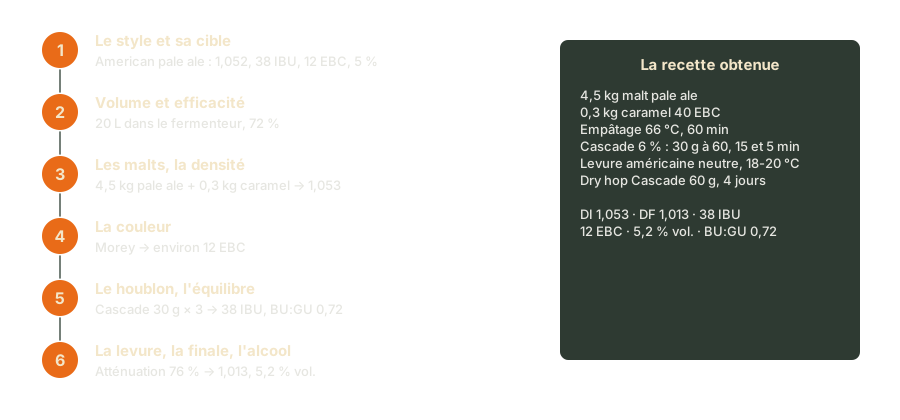
- American pale ale, 20 litres, efficiency 72 %
- 4.5 kg pale ale malt, 0.3 kg caramel 40 EBC
- Mash at 66 °C, 60 minutes, about 14 litres of water, then sparge for 26 litres before the boil (water volumes tool)
- Boil 60 minutes; Cascade 30 g at 60, 15 and 5 minutes
- Neutral American yeast, 18-20 °C, 10 to 14 days
- Dry hop Cascade 60 g, 4 days (see Getting your dry hop right)
- Estimated result: 1.053 / 1.013, 38 IBU, 12 EBC, 5.2 %, BU:GU 0.72
- Priming for 2.4 volumes: about 125 g of dextrose (priming tool)
Next: brew, measure, correct
A recipe only becomes good at the second batch. Note the gravity actually obtained (if it is 1.048 instead of 1.053, the efficiency was too optimistic, not the recipe), taste with the sheet from the tasting article, and change only one thing at a time: the dose of a hop, the share of caramel, the mash temperature. The variants of one recipe stay within the same style, which makes them comparable.
Changing scale or volume
Going from 20 to 25 litres or adapting a recipe found for 19 litres (5 gallons): the scaling tool multiplies the grains by the ratio of volumes corrected by the ratio of efficiencies, and the hops by the ratio of volumes alone.
In the app
What Krausi does
In the app, describing the beer you want ("a golden pale ale, 20 litres, well hopped with Cascade") is enough: Krausi proposes a recipe based on a reference of the style, scaled to the volume and to the measured efficiency of the set-up, taking into account the ingredient stock and the brewer's habits (BIAB, no protein rest, 60-minute boil). You confirm or change it, and it creates it with its steps and figures. The recipe table shows each ingredient's share of the gravity, colour and bitterness.
Frequently asked questions
How much malt for 20 litres of beer?
4 to 5 kg for a 5 % beer, 5.5 to 7 kg for 7 %, at 72 % efficiency. The estimated original gravity tool gives the exact value for your own efficiency.
How much hops for 20 litres?
It depends on the target IBU and the alpha acid content: 30 g of a 6 % hop for 60 minutes make about 22 IBU in 20 litres at 1.052. For an IPA at 60 IBU, count 80 to 100 g in the boil plus the dry hop.
What is the difference between an all-grain recipe and an extract recipe?
With extract, the base malts are replaced by dry or liquid extract, at 100 % efficiency: 1 kg of dry extract gives 384 points, i.e. 1.019 in 20 litres. Speciality malts are steeped. The rest of the method (hops, yeast) is identical.
How do I know whether my recipe is balanced?
By the BU:GU ratio and the style's bounds: a pale ale between 0.65 and 0.9, a malty beer below 0.5.
Can I invent a style?
Yes, but keeping the bounds of a nearby style for gravity and balance: a "styleless" beer at 1.080 and 15 IBU will be heavy whatever you put in it.
Other articles
Ready for your next brew?
Create your account, describe your first recipe to Krausi, and let him do the maths.