
4A Munich Helles
OG 1.044 to 1.048 · FG 1.006 to 1.012 · 16 to 22 IBU · 6 to 10 EBC · 4.7 to 5.4 % ABV
All about beer
A beer style is a family of beers that share an origin, ingredients and above all figures: a range of original gravity, final gravity, bitterness, colour and alcohol. The guidelines of the Beer Judge Certification Program (BJCP), in their 2021 version, describe a hundred or so styles and serve as the reference for amateur competitions the world over. For a brewer, these bounds are the starting point of every recipe: they say what a pils, a saison or a stout should measure before ingredients even come up. This page gathers them, family by family, then explains what sets each family apart.
Updated on 23 October 2026
Each family first shows three landmark styles; the others unfold. For each style: the colour of the beer, then three bars on a common scale, original gravity (1.020 to 1.120), bitterness (0 to 100 IBU) and alcohol (0 to 14 % ABV), and the bounds in figures.
4A Munich Helles
OG 1.044 to 1.048 · FG 1.006 to 1.012 · 16 to 22 IBU · 6 to 10 EBC · 4.7 to 5.4 % ABV
5D German Pils
OG 1.044 to 1.050 · FG 1.008 to 1.013 · 22 to 40 IBU · 4 to 8 EBC · 4.4 to 5.2 % ABV
9A Doppelbock
OG 1.072 to 1.112 · FG 1.016 to 1.024 · 16 to 26 IBU · 12 to 49 EBC · 7.0 to 10.0 % ABV
1A American Light Lager
OG 1.028 to 1.040 · FG 0.998 to 1.008 · 8 to 12 IBU · 4 to 6 EBC · 2.8 to 4.2 % ABV
1B American Lager
OG 1.040 to 1.050 · FG 1.004 to 1.010 · 8 to 18 IBU · 4 to 7 EBC · 4.2 to 5.3 % ABV
1C Cream Ale
OG 1.042 to 1.055 · FG 1.006 to 1.012 · 8 to 20 IBU · 4 to 10 EBC · 4.2 to 5.6 % ABV
1D American Wheat Beer
OG 1.040 to 1.055 · FG 1.008 to 1.013 · 15 to 30 IBU · 6 to 12 EBC · 4.0 to 5.5 % ABV
2A International Pale Lager
OG 1.042 to 1.050 · FG 1.008 to 1.012 · 18 to 25 IBU · 4 to 12 EBC · 4.5 to 6.0 % ABV
2B International Amber Lager
OG 1.042 to 1.055 · FG 1.008 to 1.014 · 8 to 25 IBU · 12 to 28 EBC · 4.5 to 6.0 % ABV
2C International Dark Lager
OG 1.044 to 1.056 · FG 1.008 to 1.012 · 8 to 20 IBU · 28 to 59 EBC · 4.2 to 6.0 % ABV
3A Czech Pale Lager
OG 1.028 to 1.044 · FG 1.008 to 1.014 · 20 to 35 IBU · 6 to 12 EBC · 3.0 to 4.1 % ABV
3B Czech Premium Pale Lager
OG 1.044 to 1.060 · FG 1.013 to 1.017 · 30 to 45 IBU · 7 to 12 EBC · 4.2 to 5.8 % ABV
3C Czech Amber Lager
OG 1.044 to 1.060 · FG 1.013 to 1.017 · 20 to 35 IBU · 20 to 32 EBC · 4.4 to 5.8 % ABV
3D Czech Dark Lager
OG 1.044 to 1.060 · FG 1.013 to 1.017 · 18 to 34 IBU · 34 to 69 EBC · 4.4 to 5.8 % ABV
4B Festbier
OG 1.054 to 1.057 · FG 1.010 to 1.012 · 18 to 25 IBU · 8 to 12 EBC · 5.8 to 6.3 % ABV
4C Helles Bock
OG 1.064 to 1.072 · FG 1.011 to 1.018 · 23 to 35 IBU · 12 to 18 EBC · 6.3 to 7.4 % ABV
5A German Leichtbier
OG 1.026 to 1.034 · FG 1.006 to 1.010 · 15 to 28 IBU · 3 to 8 EBC · 2.4 to 3.6 % ABV
5B Kölsch
OG 1.044 to 1.050 · FG 1.007 to 1.011 · 18 to 30 IBU · 7 to 10 EBC · 4.4 to 5.2 % ABV
5C German Helles Exportbier
OG 1.050 to 1.058 · FG 1.008 to 1.015 · 20 to 30 IBU · 8 to 12 EBC · 5.0 to 6.0 % ABV
6A Märzen
OG 1.054 to 1.060 · FG 1.010 to 1.014 · 18 to 24 IBU · 16 to 34 EBC · 5.6 to 6.3 % ABV
6B Rauchbier
OG 1.050 to 1.057 · FG 1.012 to 1.016 · 20 to 30 IBU · 24 to 43 EBC · 4.8 to 6.0 % ABV
6C Dunkles Bock
OG 1.064 to 1.072 · FG 1.013 to 1.019 · 20 to 27 IBU · 28 to 43 EBC · 6.3 to 7.2 % ABV
7A Vienna Lager
OG 1.048 to 1.055 · FG 1.010 to 1.014 · 18 to 30 IBU · 18 to 30 EBC · 4.7 to 5.5 % ABV
7B Altbier
OG 1.044 to 1.052 · FG 1.008 to 1.014 · 25 to 50 IBU · 18 to 34 EBC · 4.3 to 5.5 % ABV
8A Munich Dunkel
OG 1.048 to 1.056 · FG 1.010 to 1.016 · 18 to 28 IBU · 34 to 55 EBC · 4.5 to 5.6 % ABV
8B Schwarzbier
OG 1.046 to 1.052 · FG 1.010 to 1.016 · 20 to 35 IBU · 37 to 59 EBC · 4.4 to 5.4 % ABV
9B Eisbock
OG 1.078 to 1.120 · FG 1.020 to 1.035 · 25 to 35 IBU · 34 to 59 EBC · 9.0 to 14.0 % ABV
9C Baltic Porter
OG 1.060 to 1.090 · FG 1.016 to 1.024 · 20 to 40 IBU · 34 to 59 EBC · 6.5 to 9.5 % ABV
10A Weissbier
OG 1.044 to 1.053 · FG 1.008 to 1.014 · 8 to 15 IBU · 4 to 12 EBC · 4.3 to 5.6 % ABV
10B Dunkles Weissbier
OG 1.044 to 1.057 · FG 1.008 to 1.014 · 10 to 18 IBU · 28 to 45 EBC · 4.3 to 5.6 % ABV
10C Weizenbock
OG 1.064 to 1.090 · FG 1.015 to 1.022 · 15 to 30 IBU · 12 to 49 EBC · 6.5 to 9.0 % ABV
11B Best Bitter
OG 1.040 to 1.048 · FG 1.008 to 1.012 · 25 to 40 IBU · 16 to 32 EBC · 3.8 to 4.6 % ABV
12C English IPA
OG 1.050 to 1.070 · FG 1.010 to 1.015 · 40 to 60 IBU · 12 to 28 EBC · 5.0 to 7.5 % ABV
15B Irish Stout
OG 1.036 to 1.044 · FG 1.007 to 1.011 · 25 to 45 IBU · 49 to 79 EBC · 3.8 to 5.0 % ABV
11A Ordinary Bitter
OG 1.030 to 1.039 · FG 1.007 to 1.011 · 25 to 35 IBU · 16 to 28 EBC · 3.2 to 3.8 % ABV
11C Strong Bitter
OG 1.048 to 1.060 · FG 1.010 to 1.016 · 30 to 50 IBU · 16 to 36 EBC · 4.6 to 6.2 % ABV
12A British Golden Ale
OG 1.038 to 1.053 · FG 1.006 to 1.012 · 20 to 45 IBU · 4 to 10 EBC · 3.8 to 5.0 % ABV
12B Australian Sparkling Ale
OG 1.038 to 1.050 · FG 1.004 to 1.006 · 20 to 35 IBU · 8 to 14 EBC · 4.5 to 6.0 % ABV
13A Dark Mild
OG 1.030 to 1.038 · FG 1.008 to 1.013 · 10 to 25 IBU · 28 to 49 EBC · 3.0 to 3.8 % ABV
13B British Brown Ale
OG 1.040 to 1.052 · FG 1.008 to 1.013 · 20 to 30 IBU · 24 to 43 EBC · 4.2 to 5.9 % ABV
13C English Porter
OG 1.040 to 1.052 · FG 1.008 to 1.014 · 18 to 35 IBU · 39 to 59 EBC · 4.0 to 5.4 % ABV
14A Scottish Light
OG 1.030 to 1.035 · FG 1.010 to 1.013 · 10 to 20 IBU · 34 to 49 EBC · 2.5 to 3.3 % ABV
14B Scottish Heavy
OG 1.035 to 1.040 · FG 1.010 to 1.015 · 10 to 20 IBU · 24 to 39 EBC · 3.3 to 3.9 % ABV
14C Scottish Export
OG 1.040 to 1.060 · FG 1.010 to 1.016 · 15 to 30 IBU · 24 to 39 EBC · 3.9 to 6.0 % ABV
15A Irish Red Ale
OG 1.036 to 1.046 · FG 1.010 to 1.014 · 18 to 28 IBU · 18 to 28 EBC · 3.8 to 5.0 % ABV
15C Irish Extra Stout
OG 1.052 to 1.062 · FG 1.010 to 1.014 · 35 to 50 IBU · 59 to 79 EBC · 5.0 to 6.5 % ABV
16A Sweet Stout
OG 1.044 to 1.060 · FG 1.012 to 1.024 · 20 to 40 IBU · 59 to 79 EBC · 4.0 to 6.0 % ABV
16B Oatmeal Stout
OG 1.045 to 1.065 · FG 1.010 to 1.018 · 25 to 40 IBU · 43 to 79 EBC · 4.2 to 5.9 % ABV
16C Tropical Stout
OG 1.056 to 1.075 · FG 1.010 to 1.018 · 30 to 50 IBU · 59 to 79 EBC · 5.5 to 8.0 % ABV
16D Foreign Extra Stout
OG 1.056 to 1.075 · FG 1.010 to 1.018 · 50 to 70 IBU · 59 to 79 EBC · 6.3 to 8.0 % ABV
17A British Strong Ale
OG 1.055 to 1.080 · FG 1.015 to 1.022 · 30 to 60 IBU · 16 to 43 EBC · 5.5 to 8.0 % ABV
17B Old Ale
OG 1.055 to 1.088 · FG 1.015 to 1.022 · 30 to 60 IBU · 20 to 43 EBC · 5.5 to 9.0 % ABV
17C Wee Heavy
OG 1.070 to 1.130 · FG 1.018 to 1.040 · 17 to 35 IBU · 28 to 49 EBC · 6.5 to 10.0 % ABV
17D English Barleywine
OG 1.080 to 1.120 · FG 1.018 to 1.030 · 35 to 70 IBU · 16 to 43 EBC · 8.0 to 12.0 % ABV
18B American Pale Ale
OG 1.045 to 1.060 · FG 1.010 to 1.015 · 30 to 50 IBU · 10 to 20 EBC · 4.5 to 6.2 % ABV
20A American Porter
OG 1.050 to 1.070 · FG 1.012 to 1.018 · 25 to 50 IBU · 43 to 79 EBC · 4.8 to 6.5 % ABV
21A American IPA
OG 1.056 to 1.070 · FG 1.008 to 1.014 · 40 to 70 IBU · 12 to 28 EBC · 5.5 to 7.5 % ABV
18A Blonde Ale
OG 1.038 to 1.054 · FG 1.008 to 1.013 · 15 to 28 IBU · 6 to 12 EBC · 3.8 to 5.5 % ABV
19A American Amber Ale
OG 1.045 to 1.060 · FG 1.010 to 1.015 · 25 to 40 IBU · 20 to 34 EBC · 4.5 to 6.2 % ABV
19B California Common
OG 1.048 to 1.054 · FG 1.011 to 1.014 · 30 to 45 IBU · 18 to 28 EBC · 4.5 to 5.5 % ABV
19C American Brown Ale
OG 1.045 to 1.060 · FG 1.010 to 1.016 · 20 to 30 IBU · 36 to 69 EBC · 4.3 to 6.2 % ABV
20B American Stout
OG 1.050 to 1.075 · FG 1.010 to 1.022 · 35 to 75 IBU · 59 to 79 EBC · 5.0 to 7.0 % ABV
20C Imperial Stout
OG 1.075 to 1.115 · FG 1.018 to 1.030 · 50 to 90 IBU · 59 to 79 EBC · 8.0 to 12.0 % ABV
21B IPA Spéciales: Belgian IPA
OG 1.058 to 1.080 · FG 1.008 to 1.016 · 50 to 100 IBU · 10 to 16 EBC · 6.2 to 9.5 % ABV
21B IPA Spéciales: Black IPA
OG 1.050 to 1.085 · FG 1.010 to 1.018 · 50 to 90 IBU · 49 to 79 EBC · 5.5 to 9.0 % ABV
21B IPA Spéciales: Brown IPA
OG 1.056 to 1.070 · FG 1.008 to 1.016 · 40 to 70 IBU · 36 to 69 EBC · 5.5 to 7.5 % ABV
21B IPA Spéciales: Brut IPA
OG 1.046 to 1.057 · FG 0.990 to 1.004 · 20 to 30 IBU · 4 to 8 EBC · 6.0 to 7.5 % ABV
21B IPA Spéciales: Red IPA
OG 1.056 to 1.070 · FG 1.008 to 1.016 · 40 to 70 IBU · 22 to 34 EBC · 5.5 to 7.5 % ABV
21B IPA Spéciales: Rye IPA
OG 1.056 to 1.075 · FG 1.008 to 1.014 · 50 to 75 IBU · 12 to 28 EBC · 5.5 to 8.0 % ABV
21B IPA Spéciales: White IPA
OG 1.056 to 1.065 · FG 1.010 to 1.016 · 40 to 70 IBU · 10 to 12 EBC · 5.5 to 7.0 % ABV
21C Hazy IPA
OG 1.060 to 1.085 · FG 1.010 to 1.015 · 25 to 60 IBU · 6 to 14 EBC · 6.0 to 9.0 % ABV
22A Double IPA
OG 1.065 to 1.085 · FG 1.008 to 1.018 · 60 to 100 IBU · 12 to 28 EBC · 7.5 to 10.0 % ABV
22B American Strong Ale
OG 1.062 to 1.090 · FG 1.014 to 1.024 · 50 to 100 IBU · 14 to 36 EBC · 6.3 to 10.0 % ABV
22C American Barleywine
OG 1.080 to 1.120 · FG 1.016 to 1.030 · 50 to 100 IBU · 18 to 36 EBC · 8.0 to 12.0 % ABV
22D Wheatwine
OG 1.080 to 1.120 · FG 1.016 to 1.030 · 30 to 60 IBU · 12 to 28 EBC · 8.0 to 12.0 % ABV
23A Berliner Weisse
OG 1.028 to 1.032 · FG 1.003 to 1.006 · 3 to 8 IBU · 4 to 6 EBC · 2.8 to 3.8 % ABV
23E Gueuze
OG 1.040 to 1.054 · FG 1.000 to 1.006 · 0 to 10 IBU · 10 to 12 EBC · 5.0 to 8.0 % ABV
23G Gose
OG 1.036 to 1.056 · FG 1.006 to 1.010 · 5 to 12 IBU · 6 to 8 EBC · 4.2 to 4.8 % ABV
23B Flanders Red Ale
OG 1.048 to 1.057 · FG 1.002 to 1.012 · 10 to 25 IBU · 20 to 34 EBC · 4.6 to 6.5 % ABV
23C Oud Bruin
OG 1.040 to 1.074 · FG 1.008 to 1.012 · 20 to 25 IBU · 34 to 43 EBC · 4.0 to 8.0 % ABV
23D Lambic
OG 1.040 to 1.054 · FG 1.001 to 1.010 · 0 to 10 IBU · 6 to 12 EBC · 5.0 to 6.5 % ABV
23F Fruit Lambic
OG 1.040 to 1.060 · FG 1.000 to 1.010 · 0 to 10 IBU · 6 to 14 EBC · 5.0 to 7.0 % ABV
24A Witbier
OG 1.044 to 1.052 · FG 1.008 to 1.012 · 8 to 20 IBU · 4 to 8 EBC · 4.5 to 5.5 % ABV
25B Saison
OG 1.048 to 1.065 · FG 1.002 to 1.008 · 20 to 35 IBU · 10 to 28 EBC · 5.0 to 7.0 % ABV
26C Belgian Tripel
OG 1.075 to 1.085 · FG 1.008 to 1.014 · 20 to 40 IBU · 9 to 14 EBC · 7.5 to 9.5 % ABV
24B Belgian Pale Ale
OG 1.048 to 1.054 · FG 1.010 to 1.014 · 20 to 30 IBU · 16 to 28 EBC · 4.8 to 5.5 % ABV
24C Bière de Garde
OG 1.060 to 1.080 · FG 1.008 to 1.016 · 18 to 28 IBU · 12 to 37 EBC · 6.0 to 8.5 % ABV
25A Belgian Blond Ale
OG 1.062 to 1.075 · FG 1.008 to 1.018 · 15 to 30 IBU · 8 to 12 EBC · 6.0 to 7.5 % ABV
25C Belgian Golden Strong Ale
OG 1.070 to 1.095 · FG 1.005 to 1.016 · 22 to 35 IBU · 6 to 12 EBC · 7.5 to 10.5 % ABV
26A Belgian Single
OG 1.044 to 1.054 · FG 1.004 to 1.010 · 25 to 45 IBU · 6 to 10 EBC · 4.8 to 6.0 % ABV
26B Belgian Dubbel
OG 1.062 to 1.075 · FG 1.008 to 1.018 · 15 to 25 IBU · 20 to 34 EBC · 6.0 to 7.6 % ABV
26D Belgian Dark Strong Ale
OG 1.075 to 1.110 · FG 1.010 to 1.024 · 20 to 35 IBU · 24 to 43 EBC · 8.0 to 12.0 % ABV
27A Bière historique : Kellerbier
OG 1.048 to 1.054 · FG 1.012 to 1.016 · 25 to 40 IBU · 14 to 34 EBC · 4.8 to 5.4 % ABV
27A Bière historique : Piwo Grodziskie
OG 1.028 to 1.032 · FG 1.006 to 1.012 · 20 to 35 IBU · 6 to 12 EBC · 2.5 to 3.3 % ABV
28D Straight Sour
OG 1.048 to 1.065 · FG 1.006 to 1.013 · 3 to 8 IBU · 4 to 6 EBC · 4.5 to 7.0 % ABV
27A Bière historique : Kentucky Common
OG 1.044 to 1.055 · FG 1.010 to 1.018 · 15 to 30 IBU · 22 to 39 EBC · 4.0 to 5.5 % ABV
27A Bière historique : Lichtenhainer
OG 1.032 to 1.040 · FG 1.004 to 1.008 · 5 to 12 IBU · 6 to 12 EBC · 3.5 to 4.7 % ABV
27A Bière historique : London Brown Ale
OG 1.033 to 1.038 · FG 1.012 to 1.015 · 15 to 20 IBU · 43 to 69 EBC · 2.8 to 3.6 % ABV
27A Bière historique : Pre-Prohibition Lager
OG 1.044 to 1.060 · FG 1.010 to 1.015 · 25 to 40 IBU · 6 to 12 EBC · 4.5 to 6.0 % ABV
27A Bière historique : Pre-Prohibition Porter
OG 1.046 to 1.060 · FG 1.010 to 1.016 · 20 to 30 IBU · 39 to 59 EBC · 4.5 to 6.0 % ABV
27A Bière historique : Roggenbier
OG 1.046 to 1.056 · FG 1.010 to 1.014 · 10 to 20 IBU · 28 to 37 EBC · 4.5 to 6.0 % ABV
27A Bière historique : Sahti
OG 1.076 to 1.120 · FG 1.016 to 1.038 · 0 to 15 IBU · 8 to 43 EBC · 7.0 to 11.0 % ABV
29D Grape Ale
OG 1.059 to 1.075 · FG 1.004 to 1.013 · 10 to 30 IBU · 8 to 16 EBC · 6.0 to 8.5 % ABV
Fermented at 8-13 °C with a bottom-fermenting yeast, then stored cold for several weeks: clean, without fruity esters, malt and hops laid bare. From the lightest (American light lager, 2.8 %) to the strongest (doppelbock, eisbock, 7 to 14 %). German and Czech pils are the most brewed and the most demanding: no fault can hide in them. For the home brewer, they call for holding the temperature and for patience; the article Brewing a lager at home details the method.
Weissbier, dunkles weissbier, weizenbock: at least 50 % wheat malt and a specific yeast that produces banana and clove. Lightly bitter (8 to 30 IBU), highly carbonated, served hazy. The yeast does everything: the same recipe with a neutral yeast gives an American wheat beer (1D).
Top fermentation at 18-20 °C, yeasts that leave discreet esters and a little roundness, earthy and floral hops (Goldings, Fuggles), pale ale and crystal malts. From light bitters (3.2 %) to barley wines (12 %) by way of porters, stouts and milds. Often modest gravities and low carbonation: session beers, meant to be drunk in quantity. The English IPA (12C) is the ancestor of American IPAs, maltier and less aromatic.
The same methods as the British with more neutral yeasts and American hops rich in citrus, resin and tropical fruit (Cascade, Citra, Mosaic, Simcoe). Hop bitterness and aroma up front: pale ale 30 to 50 IBU, IPA 40 to 70, double IPA 60 to 100. The Hazy IPA (21C) turns the logic around with little calculated bitterness (25 to 60), a huge dry hop and an intended haze. American porters and stouts are hoppier and more roasted than their English models; the imperial stout (20C) reaches 8 to 12 %.
Berliner weisse, gose, lambic, gueuze, Flanders red, oud bruin: lactic bacteria and wild yeasts (Brettanomyces) take part in the fermentation, for months to years for lambics. Very low final gravities (down to 1.000), almost no bitterness (0 to 25 IBU), sourness that replaces bitterness. For the home brewer, dedicated equipment is prudent: Brettanomyces settle into plastic. The quick versions (kettle sour, souring in the kettle) are described in Homemade sour beers.
The character comes from the yeast, fermented warm (22-26 °C): pear, pepper, clove, banana depending on the strain. Sugar to raise the alcohol without weighing down (tripel, golden strong, dark strong at 7.5 to 12 %), dry finishes despite the strength, high carbonation. The witbier (24A) adds raw wheat, coriander and orange peel; the saison (25B) finishes very dry (1.002 to 1.008) with a yeast that likes heat; the bière de garde (24C) is the French version, maltier and cleaner. The Christmas beer is a tradition of this family.
Category 27 revives styles that had almost disappeared: kellerbier (an unfiltered lager), grodziskie (a Polish smoked wheat beer at 3 %), Finnish sahti, rye roggenbier, sour and smoked lichtenhainer. Categories 28 to 34 take in fruit, spiced, smoked, barrel-aged beers and those that fit nowhere: the brewer declares the base style and the special ingredient, and it is the coherence that is judged.
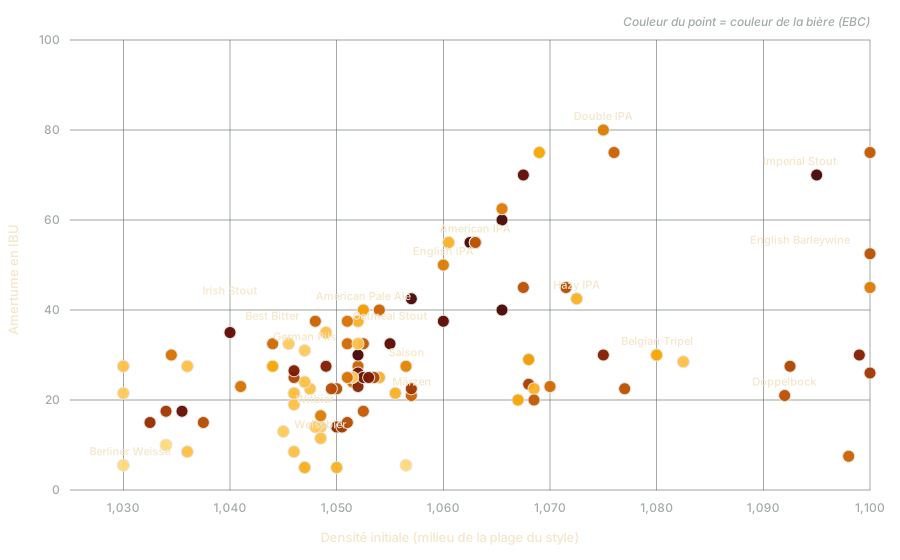
Styles are not laws. Many good beers sit between two styles; the bounds are there to know where you stand, not to forbid.
In the app
In the app, each recipe has a BJCP style (entered by its code or a word of its name); the style's limits are shown in the recipe, and Krausi knows them when it comments on the estimated gravity, bitterness, colour or alcohol. To put a recipe together, it starts from a reference of the requested style and adapts it to the volume and the set-up.
The BJCP 2021 guidelines describe a hundred or so main styles; this page gives 103 with their bounds. Other classifications (Brewers Association) count more than 150.
The yeast and the temperature: ales ferment at the top at 18-24 °C with Saccharomyces cerevisiae, lagers at the bottom at 8-13 °C with Saccharomyces pastorianus, followed by cold conditioning. Colour or strength have nothing to do with it: there are black lagers and very light ales.
A pale ale or a blonde ale: medium gravity, tolerant yeast, faults that show and can be corrected. Lagers and very strong beers demand more mastery.
The International Bitterness Unit measures the isomerised alpha acids in the beer, in mg per litre. 10 IBU is barely perceptible, 40 frankly bitter, 100 is the limit of what a beer can dissolve.
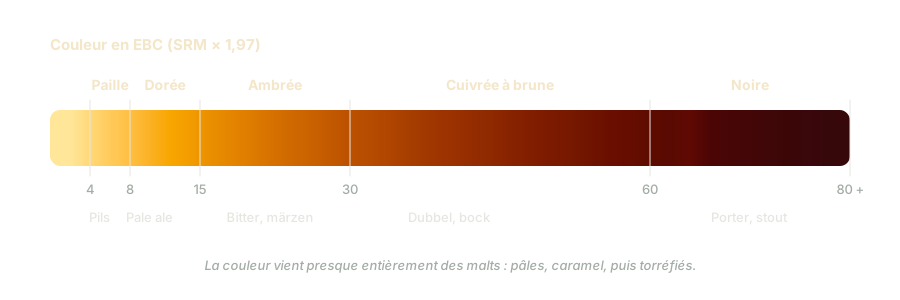
EBC = SRM × 1.97, SRM = EBC × 0.508. A beer of 20 EBC is about 10 SRM.
Create your account, describe your first recipe to Krausi, and let him do the maths.