
All about beer
Beer yeasts
The brewer makes the wort, the yeast makes the beer. It turns sugars into alcohol and CO2, but also into hundreds of aromatic compounds that make a weizen smell of banana, a saison of pepper and a pils of nothing at all, from worts that are sometimes identical. Choosing your yeast is choosing half the taste; treating it properly (quantity, oxygen, temperature) is avoiding half the faults. This page presents the families, teaches you to read a sachet and gives the dosing rules.
Updated on 23 October 2026
Reading a sachet
| Statement | What it means | What you do with it |
|---|---|---|
| Apparent attenuation, 70 to 85 % | Share of sugars consumed; sets the final gravity together with the mash temperature | High for a dry beer (saison, tripel), low for a round beer (mild, sweet stout); the estimated final gravity tool |
| Flocculation, low to high | Speed at which the yeast drops to the bottom at the end of fermentation | High: clear beer fast, but a risk of stopping early; low: lasting haze, needs cold (see hazy beer) |
| Temperature range | Range in which the strain gives its normal profile | The bottom of the range for a clean profile, the top for more esters; out of range, faults |
| Alcohol tolerance | Alcohol beyond which the yeast stops | A 9 % beer needs a strain rated at 11 % at least |
| Cells per gram, date, viability | Amount of live yeast | A dry yeast loses little in the cold; a liquid one loses 20 % a month: a starter beyond two months |
| STA1, diastatic | Strain able to cut up dextrins (saison, Belgians) | Very low final gravity; keep it away from other beers, it would contaminate a bottle and make it over-gassy |
The families
English ales
Discreet esters (pear, apple), a little malty roundness, high flocculation, medium attenuation (68 to 75 %), 18 to 20 °C. They make bitters, porters, stouts, milds, and give a clear beer within a week. Their flaw: they stop early if allowed to cool; stir them and keep them at 19-20 °C to the end.
American ales
Neutral, clean, attenuation 75 to 80 %, 18 to 22 °C: they leave room for the hops. The yeast for pale ales, IPAs, ambers, and any beer where you want to taste the ingredients rather than the fermentation. The easiest to start with.
Lagers
Bottom fermentation at 9 to 13 °C, neutral, sulphur during fermentation, attenuation 73 to 80 %, double dose and cold conditioning: see brewing a lager. A few modern dry strains tolerate 15 to 18 °C.
Belgian and farmhouse
Fruity and spicy (pear, pepper, clove), highly attenuative (80 to 90 %), fermented warm (22 to 28 °C), alcohol tolerant. They make tripels, dubbels, saisons, strong blondes. Saison strains like heat and fall asleep if the temperature drops along the way: you let them rise. Often diastatic.
German wheat
Banana (esters) and clove (phenols) for weissbiers; the balance between the two depends on temperature (warmer, more banana), on dose (underpitching, more banana) and on the ferulic acid rest at 44 °C (more clove). Low flocculation, intended haze.
Kveik
Norwegian farmhouse yeasts, 30 to 40 °C, fermentation in two days, orange and tropical fruit, need nutrients: see brewing with a kveik.
Brettanomyces and bacteria
Brettanomyces are slow wild yeasts that eat what Saccharomyces leaves and give, depending on the strain and time, pineapple, leather, farmyard, horse. Lactobacilli and pediococci acidify. Together, they make lambics, Flanders ales and wild beers; alone, added to a finished beer, a "brett beer". They need months and dedicated plastic equipment: see infected beer, since it is the same thing, intended.
Baker's, wine and champagne yeast
Baker's yeast makes beer, mediocre beer: low-flocculating, yeasty taste. Wine and champagne yeasts, very alcohol tolerant, serve to finish a very strong beer or to bottle-condition a 10 % beer, not to ferment it: they do not consume maltotriose and leave a high final gravity with a neutral taste.
Dry or liquid
| Dry | Liquid | |
|---|---|---|
| Cells | About 200 billion per 11 g sachet | About 100 billion per fresh pack, fewer with age |
| Keeping | 2 years in the cold, low losses | A few months in the fridge, 20 % loss per month |
| Preparation | Rehydrate in water at 25-30 °C for 15 minutes, or sprinkle according to the instructions | Starter above 1.050 or two months of age |
| Choice of strains | A few dozen, the main families | Several hundred, strains of specific breweries |
| Price for 20 L | Low | Two to three times more, plus the starter |
Dry yeast covers 90 % of the home brewer's needs; liquid is a must for a specific strain (a particular weizen yeast, a Belgian brewery strain) or for Brettanomyces.
How much to pitch
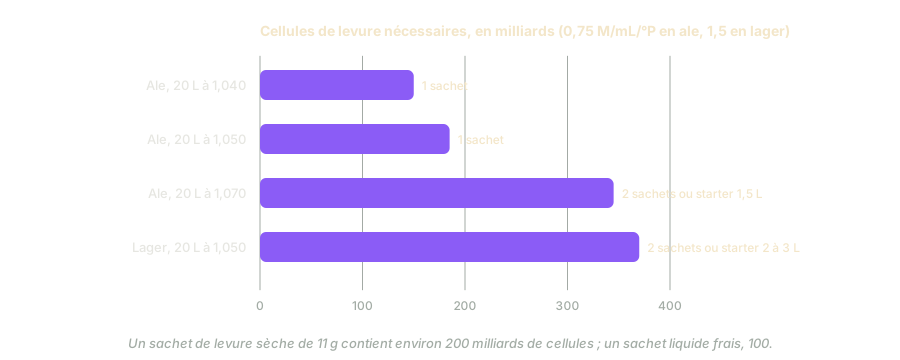
The rule: 0.75 million cells per millilitre and per degree Plato for an ale, 1.5 for a lager, and up to 1 for an ale above 1.060. For 20 litres at 1.050 (12.4 °P), that makes about 185 billion cells, one sachet of dry yeast; at 1.070, a sachet and a half; a lager, two sachets. A fresh pack of liquid yeast covers 20 litres up to 1.045; beyond that, a 1 to 2 litre starter (the yeast starter tool). The signs of underpitching: a start taking more than 24 hours, esters and fusel alcohols, acetaldehyde, high final gravity. Overpitching is rare among home brewers and gives a beer flat in aromas. The yeast pitching rate tool does the calculation for each case.
What the yeast needs
- Oxygen, once only, in the cooled wort before pitching: shake the closed fermenter for several minutes, or pour from a height. Never afterwards. The special case of dry yeasts: see below.
- Nutrients: an all-grain wort contains them; worts rich in sugar or extract, and kveik, need a little (nitrogen, zinc).
- The right temperature, that of the wort and not of the room, especially the first three days: see the fermentation guide.
- Time at the end: the two or three days when the gravity no longer moves are those when the yeast cleans up diacetyl and acetaldehyde (see off-flavours).
The case of dry yeasts
A dry yeast does not need the wort to be oxygenated. Yeast uses oxygen to make the sterols and fatty acids of its membranes, which it needs to multiply; but dry yeast was produced under highly aerated conditions and its reserves are already built when it goes into the sachet. The producers (Fermentis, Lallemand) state that a sachet dosed according to their chart does without oxygenation, and that an over-aerated wort only produces more yeast at the expense of aromas. For a liquid yeast or a yeast harvested from a previous batch, oxygenation remains necessary: those cells have used up their reserves.
Some brewers replace the oxygenation of a liquid yeast with a few drops of olive oil in the starter, to supply directly the fatty acids the yeast would make with oxygen. The idea comes from a research project at New Belgium (2005); home brewers' trials give beers without a marked fault but often a little less lively in aromas, and the useful dose is in the order of one drop for 20 litres, hard to measure. Treat it as an experiment, not as an established method.
Reusing your yeast
The sediment at the end of fermentation holds enough yeast for three or four batches. Harvest a jar of the sediment of a low-alcohol, lightly hopped beer, keep it in the fridge for two to three weeks at most, and pour 100 to 150 ml of it for 20 litres. Beyond five generations, or after a strong or very hoppy beer, start again from a new sachet: the yeast drifts and weakens. Kveik are the exception and are reused for dozens of generations.
Replacing a yeast
Two strains of the same family, with similar attenuation and temperature, replace each other almost without changing the beer; changing family changes the beer. The ingredient equivalences list, for each commercial strain, the strains with the same profile from the other producers, with their attenuation and flocculation.
In the app
What Krausi does
The recipe estimates the final gravity and the alcohol from the yeast's attenuation, and the ingredient catalogue keeps each strain's sheet (family, form, attenuation, flocculation, temperature range, alcohol tolerance). When asked how much yeast to pitch, Krausi uses the pitching rate tool, according to gravity, volume and ale or lager type.
Frequently asked questions
Should you oxygenate the wort with a dry yeast?
No: a dry yeast rehydrated or sprinkled into an unaerated wort ferments normally, its reserves are built at manufacture. Oxygenation remains useful for a liquid or harvested yeast.
Which yeast to start with?
A neutral American ale dry yeast: tolerant, fast, clean, it shows what you brewed.
Should you rehydrate dry yeast?
Follow the producer's instructions: most accept direct sprinkling, rehydration in lukewarm water gives a faster start and matters for lagers.
How long can you keep a yeast?
Dry: until the date, in the fridge, 2 years. Liquid: a few months, with a starter past two months. Harvested sediment: two to three weeks.
Can you mix two yeasts?
Yes; the faster one dominates the fermentation, the other marks the finish. A classic: a Belgian and a neutral one to temper the fruitiness.
Does yeast give you a headache?
No; that is the higher alcohols of a fermentation that was too warm or underpitched, and the quantity drunk.
Other articles
Ready for your next brew?
Create your account, describe your first recipe to Krausi, and let him do the maths.