
All about beer
Sour or infected beer: recognising a contamination and reacting
Boiling wort is sterile; everything that touches it afterwards can leave bacteria or wild yeast in it. Most of the time the brewing yeast, massive and fast, smothers them. Sometimes not, and the beer turns: sour, hazy, over-carbonated, with a film on the surface. This page teaches you to recognise a contamination without confusing it with a normal fermentation, says what you can drink, and above all explains how to stop it coming back, because an infection that hits two batches in a row comes from the equipment, not from bad luck.
Updated on 23 October 2026
What is normal and gets mistaken for an infection
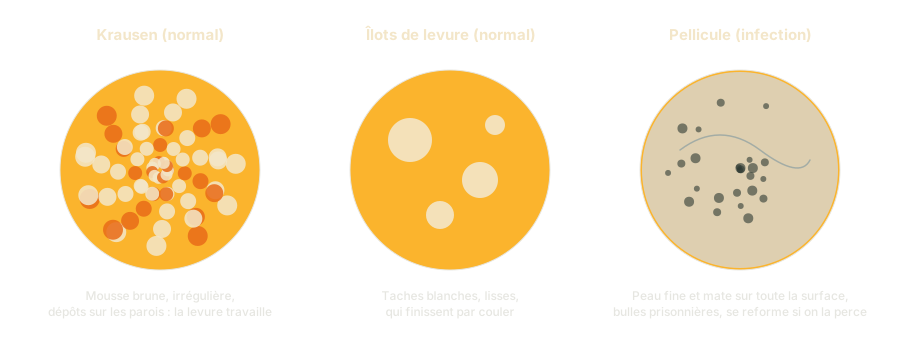
- The krausen: the thick, brown, irregular foam, with brown deposits on the walls during fermentation. That is the yeast at work.
- The islands of yeast floating after fermentation, white, smooth, which end up sinking.
- The sulphur smell of a young lager, or the green-apple smell of a young ale.
- Hop bubbles on the surface after a dry hop.
- A yeast haze (see hazy beer).
None of these signs, on its own, is an infection. You never throw a batch away on looks: you taste.
The signs of a real contamination
| Sign | What it probably is |
|---|---|
| A thin, matt film, white or grey, covering the whole surface like a skin and re-forming when you pierce it; sometimes with trapped bubbles | Wild yeast (Brettanomyces), acetic bacteria, or surface yeasts (Kahm) |
| Beer that turns sour and sharp when it was not at racking | Lactic bacteria (Lactobacillus, Pediococcus): clean, lactic sourness |
| Taste of vinegar, smell of solvent | Acetic bacteria, which need air: fermenter not properly closed, empty airlock, keg without purging |
| Bottles getting more and more gassy over months, sometimes after a quiet period; beer that turns dry and thin | Brettanomyces, which eat the sugars the brewing yeast leaves behind |
| Strands, viscous beer that pours like oil | Pediococcus or other bacteria producing exopolysaccharides ("ropy beer"); sometimes temporary |
| Raised, fuzzy, coloured spots, green, black or blue | Mould: the only case where you throw it away without tasting |
| Butter taste that grows over time, with sourness | Pediococcus (the diacetyl of a healthy yeast, by contrast, decreases) |
| Smell of clove, farmyard, horse, in a beer that should not have any | Wild yeast or Brettanomyces |
What to do with the batch
- Mould: throw it away. Moulds can produce toxins and the beer is not worth the risk.
- Lactic sourness, Brettanomyces, a film without mould: the beer is not dangerous (the low pH and the alcohol keep pathogens out). If it is good, drink it; if it is sour but clean, letting it evolve for six months can give an interesting sour beer; if it is unpleasant, throw it away. Do not bottle it in ordinary bottles if it is still gassing: refrigerate and drink, or use thick bottles.
- Vinegar: rarely salvageable beyond a slight sharpness.
- In every case, do not put this beer in bottles that you keep for months in the warm: the contamination keeps working in them.
Where it comes from
In order of frequency for the home brewer:
- Scratched plastic: fermenter, priming bucket, tubing, racking cane. Scratches shelter bacteria that the sanitiser cannot reach. A plastic bucket is replaced every two or three years, a tube that has turned opaque straight away.
- Taps and fittings: never dismantled, they keep beer in the seal.
- The chiller: a coil or plates poorly rinsed keep sugary wort that goes mouldy; the chiller touches the cooled wort, it is the most critical piece.
- The empty airlock or badly closed lid: entry of air and of fruit flies, which carry acetic bacteria.
- The hydrometer and the trial jar, dipped into the fermenter without sanitising.
- Badly rinsed bottles: an infection in just a few bottles comes from them.
- The time between chilling and pitching: a cooled wort left overnight without yeast gives the microbes the advantage.
- Fruit, whole-cone dry hops or spices added after the boil: rarely, but possible.
Cleaning and sanitising: the difference
Cleaning removes matter (deposits, dried krausen, grease); sanitising kills what is left on a clean surface. A sanitiser on a dirty surface is useless. The sequence for everything that touches the cooled wort: rinse immediately after use, clean with an alkaline brewery cleaner (percarbonate or oxygen-based cleaner, dosed with the cleaning and sanitising products tool, soaking for 30 minutes to 1 hour, hot water), rinse, then sanitise just before use (no-rinse acid sanitiser, contact time of one to two minutes, or another sanitiser according to its instructions). Never mix products.
After an infection: the big clean
- Dismantle everything: taps, seals, fittings, airlocks. Soak in the alkaline cleaner overnight.
- Replace all tubing, the racking cane, the tap seals, and any scratched or opaque plastic. It is the cheapest expense in all of brewing.
- For stainless steel and glass, after the alkaline clean, a long sanitising (soaking for several hours) or a pass with very hot water.
- Check the chiller: circulate hot cleaner through it, rinse thoroughly, sanitise it at every batch.
- If the infection was intended elsewhere (a sour beer, a homemade lambic), dedicate plastic equipment to those beers; Brettanomyces settle in for a long time.
In the app
What Krausi does
A "sour" fault is ticked on the batch's tasting sheet. Krausi can read the tasting sheets and the measurements of the batch to discuss them, and note in the recipe's notebook what was replaced or changed, so it is remembered at the next batch.
Frequently asked questions
Is an infected beer dangerous?
No, except for visible mould. The beer's pH and alcohol stop pathogenic bacteria from growing in it. The risk is the taste, and bottles that burst.
There is a white film on my beer, what should I do?
Taste below the film with a sanitised utensil. If the beer is good, bottle quickly leaving the film behind, refrigerate, drink; if it is sour or strange, decide by taste. Then replace the plastic.
Why are my beers always a little sour?
A contamination settled in the equipment: scratched fermenter, tap or tubing. Replacing all the plastic and dismantling the taps solves the problem in the vast majority of cases.
Should you sanitise dry hops?
No, hops are antiseptic. Sanitise the bag and everything used to add them.
Do white vinegar or bleach sanitise equipment?
Bleach sanitises but needs thorough rinsing (chlorophenols, corrosion of stainless steel); vinegar alone does not sanitise enough. No-rinse brewery sanitisers are safer and simpler.
Other articles
Ready for your next brew?
Create your account, describe your first recipe to Krausi, and let him do the maths.