
All about beer
Hops
Hops bring beer its bitterness, its aroma and part of its keeping qualities. They are the female cones of a climbing plant, Humulus lupulus, dried and most often compressed into pellets. Two figures on a packet are enough to use them: the alpha acid content, which makes the bitterness, and the amount of oils, which makes the aroma. This page explains those figures, the forms, the main families, storage, and how to replace a hop you cannot find.
Updated on 23 October 2026
Alpha acids: bitterness
Hop alpha acids are insoluble and without bitterness until they are isomerised by heat: it takes the boil, and time. The earlier the addition, the higher the bitterness; after 60 minutes, most of it is done (about 25 to 30 % of the alpha acids have been isomerised in a wort of average gravity). The alpha acid content ranges from 3 % (Saaz) to 18 % (Magnum, Columbus, Warrior) and changes every year with the harvest: redo the calculation with the figure on the packet you bought. The Tinseth formula, used by the IBU tool, gives the bitterness according to weight, alpha, time, volume and wort gravity (the denser the wort, the less the hops isomerise). Guideline: 30 g of a 6 % hop for 60 minutes in 20 litres at 1.050 make about 22 IBU in pellets.
Essential oils: aroma
Aroma comes from the oils (myrcene, humulene, caryophyllene, farnesene and hundreds of minor compounds), which evaporate in the boil. Hence the rule: bitterness at the start, aroma at the end. An addition at 15 minutes keeps a little aroma and still gives bitterness; at 5 minutes or at flame-out, mostly aroma; in a whirlpool at 80 °C for 20 minutes, aroma and a little bitterness (the IBU tool takes it into account); as a dry hop, aroma only (see getting your dry hop right). An "aroma" hop has more oils (1.5 to 3 ml per 100 g) than a "bittering" hop (0.5 to 1 ml), but any hop can do both.
The forms
| Form | What it is | Advantages | Drawbacks |
|---|---|---|---|
| Whole cones | The dried cone as is | Natural filter at the end of the boil, looks | Bulky, absorbs a lot of wort (about 6 L/kg), ages fast, extracts 10 % less than pellets |
| T90 pellets | Ground and compressed cones | The standard: keeps, doses, extracts well | Fine sediment to separate (whirlpool, bag) |
| T45 pellets, cryo, lupulin | Concentrate of lupulin glands, stripped of part of the plant matter | Twice the alpha and oils per gram: less vegetal and less volume lost in dry hopping | Price, dose to divide by 1.5 to 2 |
| Extracts (CO2, isomerised) | Extracted resins | Bitterness without matter, precise dosing | Uncommon among home brewers |
| Fresh hops (harvest) | Cones picked the same day, not dried | Unique green, grassy aroma, once a year in September | Water content 80 %: count 5 to 6 times the weight in pellets; unknown alpha |
The main families
| Family | Hops | Profile | Beers |
|---|---|---|---|
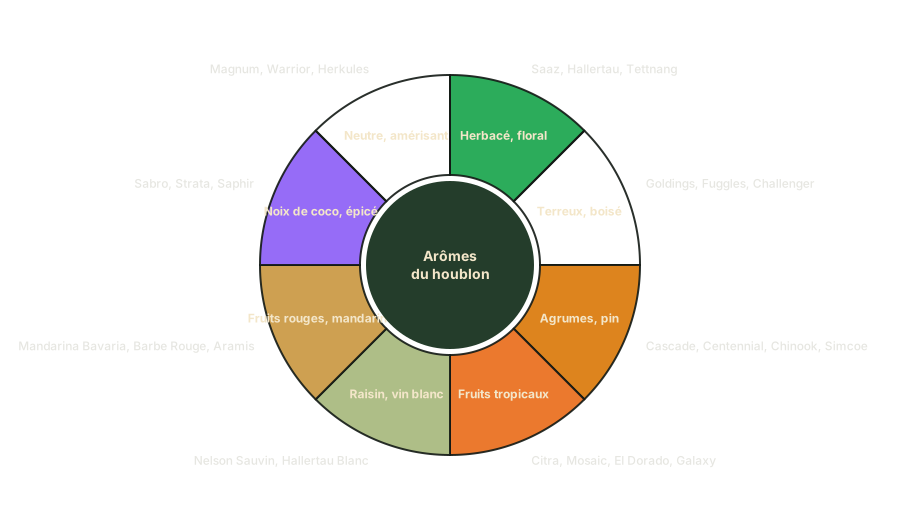
| Noble, continental Europe | Saaz, Hallertau Mittelfrüh, Tettnang, Spalt; close to them: Perle, Hersbrucker, Strisselspalt (Alsace) | Grass, hay, flowers, mild spice; low alpha 3 to 6 % | Pils, helles, lagers, kölsch, Belgian beers |
| English | East Kent Goldings, Fuggles, Challenger, Target, First Gold | Earth, wood, tea, candied fruit; alpha 4 to 11 % | Bitters, porters, stouts, English IPA |
| Classic American | Cascade, Centennial, Chinook, Columbus, Simcoe, Amarillo | Grapefruit, pine, resin, citrus; alpha 6 to 15 % | Pale ale, West Coast IPA, ambers |
| Modern American | Citra, Mosaic, El Dorado, Idaho 7, Sabro, Strata | Tropical fruit, mango, passion fruit, coconut (Sabro) | NEIPA, IPA, pale ale |
| Pacific | Nelson Sauvin, Motueka, Riwaka (New Zealand); Galaxy, Vic Secret, Ella (Australia) | White grape, lime, passion fruit | IPA, pale ale, modern pils |
| Modern German | Mandarina Bavaria, Hallertau Blanc, Huell Melon, Saphir | Mandarin, white wine, melon | German pale ales, hoppy lagers |
| French | Strisselspalt, Aramis, Triskel, Barbe Rouge, Mistral | Floral, red fruit, soft citrus | Blondes, bières de garde, pale ale |
| Pure bittering | Magnum, Warrior, Herkules, Polaris | Neutral, alpha 12 to 20 % | The 60-minute addition of any beer |
Storing hops
Hops lose their alpha acids and oils with heat, air and light. A vacuum-packed or nitrogen-flushed packet, in the freezer, keeps most of it for two or three years; the same packet open in a cupboard has lost 30 to 50 % of its alpha in six months, and smells of cheese. Once open: squeeze out the air, reseal tightly, put back in the freezer, and use it within three months for a dry hop. Producers give a storage index (HSI): high-alpha hops and noble varieties keep less well than average. An aged hop is still fine for bittering, with a higher dose, not for aroma.
Dosing
- First set the style's IBU (the list of styles) and the wanted BU:GU ratio (creating your recipe).
- Split it: 50 to 70 % of the IBU from the 60-minute addition, the rest from the late additions; the IBU tool calculates each addition, the boil schedule tool gives the times.
- Aroma at the end of the boil: 1 to 2 g/L for a pale ale, 2 to 4 g/L for an IPA, on top of which comes the dry hop.
- Fresh harvest hops: 5 to 6 times the planned weight of pellets, at the end of the boil only, unknown alpha.
Replacing a hop that is out of stock
For bitterness, any neutral hop will do, correcting the quantity by the ratio of alphas: 30 g at 6 % are replaced by 18 g at 10 %. For aroma, you look for the same family and similar oils: Cascade by Centennial or Amarillo, Saaz by Tettnang or Sterling, Citra by Mosaic or Galaxy, East Kent Goldings by Fuggles or Styrian Goldings. The hop substitution tool gives the matches and recalculates the quantity; the ingredient equivalences classify hops by use, aroma, origin and alpha, and know which ones are on sale in the shops.
In the app
What Krausi does
The app recalculates a recipe's IBU as soon as the real alpha of the packet is entered, and the boil timer announces each addition. Krausi looks for a hop's equivalents (use, alpha, aromas, origin) and flags those in stock. The ingredient catalogue keeps each hop's sheet (alpha, beta, cohumulone, aromas, use, origin).
Frequently asked questions
What is the difference between a bittering hop and an aroma hop?
The first has a lot of alpha acids and few oils, the second the opposite. Any hop can bitter at the start of the boil; only aroma hops are worth it at the end of the boil and in dry hopping.
How long do hops keep?
Two to three years vacuum-packed in the freezer; a few months open in the freezer; a few weeks in the open air.
Pellets or cones?
Pellets: simpler, more stable, better extraction. Cones remain of interest for fresh hops from your own harvest.
How do you calculate the amount of hops?
From the target IBU, the alpha of the packet, the time and the volume, with the Tinseth formula: the IBU tool does it for each addition.
Can you grow your own hops?
Yes, it is a hardy plant that produces from the second year in a temperate climate. The alpha is unknown: use the harvest for aroma at the end of the boil or in dry hopping, counting generously.
Other articles
Ready for your next brew?
Create your account, describe your first recipe to Krausi, and let him do the maths.