
All about beer
Malts
Malt is barley (or wheat, rye, oats) that has been germinated then dried: germination makes the enzymes that, in the mash, will turn starch into sugar, and drying sets the colour and the taste. From biscuit to coffee by way of caramel, all the malt flavours of a beer come from the way it was dried and roasted. This page explains the families, gives for each the yield and colour the calculators use, the proportions that work, and what you need to know about milling and storage.
Updated on 23 October 2026
How malt is made
- Steeping: the grain is hydrated for two days up to 45 % moisture.
- Germination: four to six days in the cool; the grain produces its enzymes and starts digesting its cell walls. This is what makes it "friable".
- Kilning: drying with hot air. At 80-85 °C, a very pale pilsner malt; at 100-105 °C, a pale ale or Vienna malt; at 110-120 °C, a Munich. The hotter, the more colour and bread aroma, and the fewer enzymes remain.
- For caramel malts: the germinated grain, still moist, is heated to 65-75 °C in a drum, which performs the mash inside the grain, then roasted: the sugar caramelises in place. These malts have no enzymes left and bring unfermentable sugars.
- For roasted malts: the dry malt (or unmalted barley) is roasted at 200-230 °C like coffee.
The families and their figures
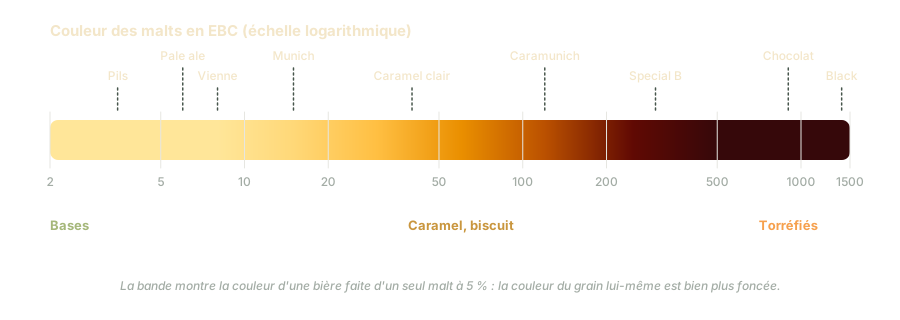
The yield is the share of the mass that becomes extract (what the estimated original gravity tool multiplies by the efficiency); the colour is the malt's, which the Morey formula converts into beer colour in the EBC tool. The values are orders of magnitude, each malt's sheet is the reference.
| Family | Examples | Malt colour (EBC) | Yield | Enzymes | Usual share | Taste |
|---|---|---|---|---|---|---|
| Pale base | Pilsner, pale ale, Maris Otter, extra pale | 3 to 7 | 0.80 to 0.82 | Strong | 60 to 100 % | Grain, fresh bread, light biscuit |
| Coloured base | Vienna, Munich, mild ale | 7 to 25 | 0.78 to 0.80 | Enough to convert themselves | 10 to 100 % | Toast, crust, malt |
| Malted wheat | Pale wheat, dark wheat | 4 to 15 | 0.82 to 0.84 | Strong | 5 to 70 % | Bread, head, roundness; no husk, slower lautering |
| Caramel, crystal | Carapils, caramel 20 to 400 EBC, caramunich, Special B | 3 to 400 | 0.72 to 0.76 | None | 3 to 10 % | Caramel, toffee, dried fruit, raisin (Special B); body and sweetness |
| Biscuit, aromatic | Biscuit, aromatic, melanoidin, amber | 30 to 80 | 0.75 to 0.78 | Weak or none | 3 to 10 % | Dry biscuit, well-toasted bread, hazelnut |
| Roasted | Chocolate, Carafa, black, roasted barley | 600 to 1,500 | 0.65 to 0.72 | None | 1 to 8 % | Coffee, cocoa, ash; the "dehusked" versions are softer |
| Smoked | Rauchmalz (beech), peated | 4 to 8 | 0.80 | Strong | 5 to 100 % | Smoke, ham; peated is very dominant |
| Acidulated | Acid malt (Sauermalz) | 3 to 6 | 0.78 | Weak | 1 to 5 % | Lowers the mash pH, 1 % for about 0.1 unit |
| Flakes and raw grains | Flaked oats, wheat, barley, maize, rice, raw wheat | 2 to 5 | 0.70 to 0.80 | None | 5 to 40 % | Texture, haze, head (wheat), silky roundness (oats), lightness (maize, rice) |
Enzyme rule: at least 60 to 70 % of the grist must be a base malt to convert the rest. Above 30 % of flakes and caramels, conversion slows and the yield drops (see efficiency).
The proportions that work
| Beer | Base | Additions |
|---|---|---|
| Pils, helles, blonde | 95 to 100 % pilsner | 0 to 5 % carapils or Vienna |
| Pale ale, IPA | 85 to 95 % pale ale | 5 to 10 % light caramel (20 to 60 EBC); in a NEIPA, replace with 15 to 25 % flaked oats and wheat |
| Amber, bitter | 80 to 90 % pale ale or Maris Otter | 5 to 12 % medium caramel (60 to 150 EBC), 2 to 5 % biscuit |
| Weizen | 50 to 70 % malted wheat | 30 to 50 % pilsner, sometimes 3 % caramel |
| Porter, stout | 70 to 85 % pale ale | 5 to 10 % dark caramel, 3 to 8 % chocolate or roasted barley (stout), 5 to 10 % flaked oats (oatmeal stout) |
| Dubbel, Christmas beer | 75 to 85 % pilsner | 10 to 15 % Munich, 5 % caramunich, 2 to 3 % Special B, 5 to 10 % candi sugar |
| Märzen, bock | 50 to 100 % Munich and Vienna | 0 to 50 % pilsner, 0 to 5 % caramunich |
The classic mistakes: more than 10 % caramel (a sweet, heavy beer), roasted malts in a beer that should be amber (ash taste), mixing everything "for complexity" (a brown beer with no character). A recipe with two or three well-chosen malts beats a recipe with seven. The full method is in creating your own recipe.
Reading a malt sheet
- Colour: in EBC in Europe, in degrees Lovibond in the United States (EBC ≈ Lovibond × 2.65 − 1.2).
- Extract: "fine grind, dry basis" as a percentage, that is the yield (80 % = 0.80).
- Diastatic power (Windisch-Kolbach or Lintner): the strength of the enzymes; a pilsner at 250 WK easily converts 30 % of flakes, a Munich at 100 WK just converts itself.
- Protein, Kolbach: useful to breweries, little to the home brewer.
- Moisture: above 6 %, the malt has taken on moisture and aged.
Milling
The grain must be split, the inside broken into a few pieces and the husk whole: the husk makes the filter in three-vessel and all-in-one systems. Too coarse, the yield drops; too fine, lautering sticks and the tannins of the crushed husk pass through (astringency). In BIAB, the bag filters and you can mill finer, which makes up for the lack of sparging. Buying crushed malt is convenient; the supplier's crush is often coarse and crushed malt oxidises within a few weeks. A roller mill set at 1 to 1.2 mm is the investment that changes the yield most.
Storing
Whole malt: a year dry, cool, away from rodents and pantry moths, in a closed container; beyond that, the cardboard taste appears. Crushed malt: three to four weeks. Roasted and caramel malts keep better than pale bases. A malt that is no longer crunchy between the teeth has taken on moisture: it will convert less well and give off-flavours.
Replacing a malt
Within the same family and the same colour, two malts replace each other almost identically: a pale ale by a Maris Otter (a little more biscuit), a 120 EBC caramel from one maltster by another's. Changing family changes the beer. The ingredient equivalences classify malts by type, colour and grain, and say which ones are in stock in the shops; the app's ingredient catalogue gives the yield and colour of each sheet.
In the app
What Krausi does
The recipe in the app calculates gravity and colour from the malt sheets, and shows each malt's share of the gravity, colour and alcohol. An unknown malt entered by the brewer is researched and its sheet completed (yield, colour), to be checked.
Frequently asked questions
What is the difference between pilsner malt and pale ale malt?
The kilning: pilsner at 80-85 °C stays very pale (3 to 4 EBC) and grainy; pale ale at 100-105 °C is a little more golden (5 to 7 EBC) and biscuity. Both have enough enzymes to convert everything.
How much caramel malt should you use?
3 to 10 % of the grist. Beyond that, the beer becomes sweet and heavy.
Should you mill the malt yourself?
It is not compulsory, but a fresh, properly set crush gains 5 to 10 points of efficiency and avoids crushed malt that ages.
How long does malt keep?
A year whole, dry and cool; a month crushed.
What is a dehusked malt?
A roasted malt whose husk was removed before roasting: it colours as much but without the harshness and ash. For soft black beers and for darkening a beer without a coffee taste.
Other articles
Ready for your next brew?
Create your account, describe your first recipe to Krausi, and let him do the maths.