
All about beer
Hazy beer: the causes and how to clarify
A hazy beer is not necessarily a failure: a weissbier, a witbier or a Hazy IPA are hazy by definition. But a pils or a pale ale that you wanted brilliant and that stays veiled raises a question: hazy with what? There are five different hazes, which are not treated the same way, and a simple test to tell them apart. This page reviews them, then the clarification methods within reach without filtration.
Updated on 23 October 2026
The five hazes
| Haze | Appearance | Test | Origin | Treatment |
|---|---|---|---|---|
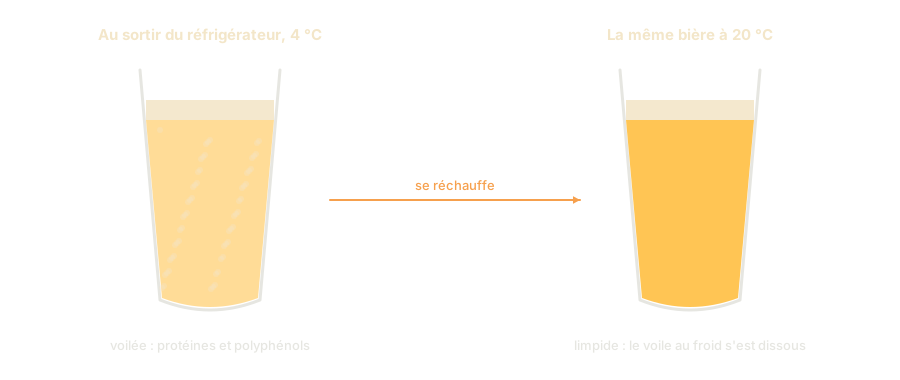
| Chill haze | Beer clear at 20 °C, veiled in the fridge, turns clear again as it warms | Take a glass out of the cold and let it come back to temperature | Protein-polyphenol complexes that precipitate in the cold | Cold conditioning 1 to 3 weeks then racking, Irish moss in the boil, finings (gelatine, PVPP), a vigorous boil |
| Yeast in suspension | Uniform, milky haze, sediment that re-forms; yeasty taste | The haze does not disappear on warming; settles within a few days in the cold | Low-flocculating yeast (wheat, Belgian, kveik, some American strains), beer too young, shaken bottle | Time, cold, gelatine; choose a more flocculent yeast; pour leaving the sediment behind |
| Starch | Permanent, opaque haze that never settles; sometimes a floury taste | Iodine test on a sample: turns blue-black | Incomplete conversion in the mash (temperature, duration, pH, too much raw grain without enzymes) | Nothing for this batch. Next time: a complete saccharification rest, iodine test before sparging |
| Hops | Green-yellow haze, sometimes greasy, after a big dry hop | Linked to the dry hop, appears with it | Hop polyphenols and particles; sought after in a NEIPA | Cold conditioning, a bag for the hops, finings; or accept it |
| Bacteria or wild yeast | Haze that appears after the beer was clear, often with sourness or a film on the surface | Taste; evolution over time | Contamination | See infected beer |
Two special cases: fruit brings pectin, which hazes lastingly (a pectic enzyme avoids it); a beer chilled too fast after the boil without a "cold break" leaves proteins that end up in the fermenter.
Preventing it in the boil and at chilling
- A vigorous boil of at least 60 minutes: it coagulates proteins (hot break), which you can see floating in flakes.
- Irish moss: a red seaweed (Chondrus crispus, rich in carrageenan) sold dried under its English name, never translated, or as tablets of purified carrageenan (Whirlfloc, Protafloc: one tablet for 20 to 40 litres depending on the brand). It charges the proteins and makes them drop out at chilling. Dose: 1 g of flakes, or one tablet, for 20 litres in the last 10 to 15 minutes of the boil. It is the most effective measure against chill haze, and the cheapest.
- Chill fast: the cold break, those proteins that precipitate when passing below 60 °C, forms better with fast chilling, and falls to the bottom of the kettle.
- Whirlpool: spin the wort to gather hops and proteins in the centre, then draw off from the side.
Clarifying after fermentation
- Time and cold: keeping the beer at 0-4 °C for 3 days to 3 weeks drops the yeast and a large part of the haze. It is the lager method and the only one that needs nothing but a cold place.
- Gelatine: half a teaspoon (about 2.5 g) of food gelatine dissolved in 100 ml of water heated to 60-65 °C without boiling, poured into the cold beer (below 10 °C), drops yeast and haze in 2 to 3 days. Effective and cheap; not suitable for a vegetarian beer.
- Vegetable or mineral finings: PVPP (binds polyphenols, chill haze), silica or chitosan for yeast, bentonite rarely in beer. All are dosed according to the instructions, in cold beer.
- Racking: after cold conditioning, transfer leaving the sediment behind, without shaking (see oxidation to do it without air).
- Filtration: out of ordinary reach for a home brewer without a keg and gas; and it removes the yeast needed for bottle conditioning.
Careful: every clarification removes yeast. For a heavily clarified beer bottle-conditioned afterwards, add a pinch of dry yeast at priming (see flat beer).
Choosing the yeast
Flocculation, stated on every sachet (low, medium, high), says whether the yeast drops to the bottom on its own at the end of fermentation. English yeasts flocculate strongly and give a brilliant beer within a week; American ones moderately; wheat, Belgian and kveik yeasts stay in suspension and need cold or finings. The site's ingredient equivalences give the flocculation of each strain.
When the haze is intended
Weissbier, witbier, Hazy IPA, kellerbier, sometimes saison: the haze comes from yeast in suspension, wheat or oat proteins, and hops. To keep it: a low-flocculating yeast, flaked wheat or oats (20 to 40 %), no Irish moss, no long cold conditioning, dry hopping during fermentation. A stable, even haze is a success in these styles; a haze that drops as sediment within a few days is just yeast.
In the app
What Krausi does
Krausi knows a yeast's flocculation when its catalogue sheet gives it. On request, it adds Irish moss to the recipe as an adjunct, with its addition time: the boil timer announces it like a hop; it puts a reminder for the cold conditioning in the calendar.
Frequently asked questions
Why is my beer hazy in the fridge and clear at room temperature?
That is chill haze, proteins and polyphenols. No effect on taste; Irish moss in the boil and cold conditioning before bottling fix it.
How do you clarify beer without a filter?
Cold for one to three weeks, then gelatine if that is not enough; and pour leaving the sediment in the bottle.
Does haze change the taste?
Chill haze does not. Yeast in suspension gives a yeasty taste and body; starch a floury taste and an unstable beer.
How long to wait for the beer to be clear?
A week in the cold for a flocculent yeast, three weeks for a low-flocculating one. In the bottle at 20 °C, the yeast drops in 2 to 4 weeks.
Can you put gelatine in the fermenter?
Yes, in beer chilled below 10 °C, at the end of fermentation, 2 to 3 days before racking or bottling.
Other articles
Ready for your next brew?
Create your account, describe your first recipe to Krausi, and let him do the maths.