
All about beer
Serving beer
A beer brewed with care for two months is decided in thirty seconds at serving time. Too cold, it smells of nothing; poured in one go, it overflows or stays flat; the yeast sediment poured with it makes it hazy and acrid. This page gives the temperature by style, the glass, the technique for a bottle-conditioned beer, the head, and the settings of a keg. The tasting itself, criterion by criterion, is in How to taste beer.
Updated on 23 October 2026
Temperature
Cold numbs the aromas and heightens the perception of gas and bitterness; warmth releases the aromas and brings forward alcohol and sweetness. Rule: the lighter and paler the beer, the colder it is served; the stronger and darker, the more temperate. The 4 °C of a fridge suit a light lager and nothing else; take the bottle out 15 to 30 minutes ahead for most beers.
| Temperature | Styles |
|---|---|
| 4 to 7 °C | Light lagers, pils, helles, American wheat beers, Berliner weisse, gose |
| 7 to 10 °C | Pale ale, blonde, kölsch, witbier, weissbier, session IPA, saison |
| 10 to 13 °C | IPA, NEIPA, ambers, bitter, porter, dubbel, märzen, bock |
| 13 to 16 °C | Strong stouts, tripel, dark abbey beers, Christmas beer, barley wine, old ale, lambic and gueuze |
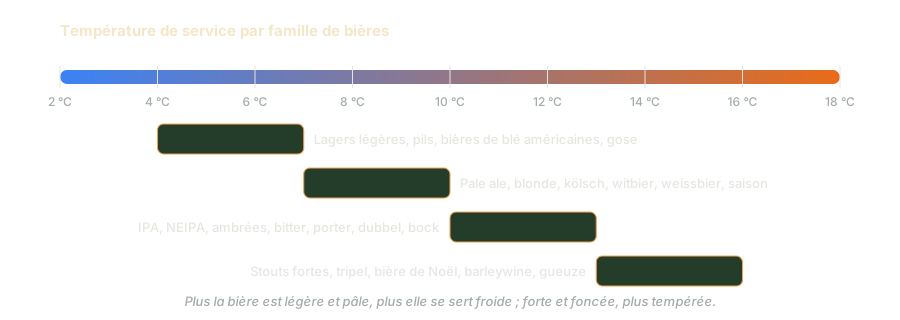
Beer warms up by 1 °C every 2 to 3 minutes in a glass at room temperature: serve slightly cooler than the target and let it evolve. A beer that is too warm does not cool down in the glass.
The glass
- "Beer clean": no grease, no residue of washing-up liquid or tea towel, which kill the head. Rinsed with clear water just before, a wet glass receives the beer better and foams less.
- The shape changes the experience: a glass that narrows at the top (tulip, wine glass, snifter) concentrates the aromas for IPAs, Belgians and strong beers; a tall, narrow glass (flute, pilsner glass) shows off clarity and holds the head for lagers; the weizen glass, tall and flared, takes the abundant head of wheat beers; a straight or slightly flared pint suits bitters, stouts and pale ales. A single 33 to 40 cl tulip glass suits almost everything.
- A stemmed glass avoids warming the beer with your hand.
Pouring a bottle-conditioned beer
A homebrew conditioned in the bottle has a yeast sediment at the bottom. It is not harmful and some styles (weizen) pour it on purpose, but for most beers it clouds, gives a yeasty taste and an acrid bitterness.
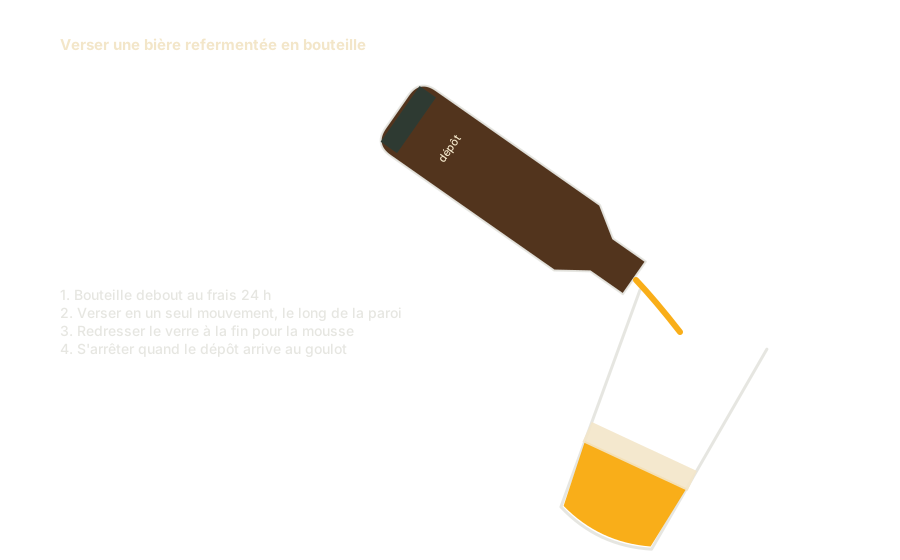
- Leave the bottle standing upright in the cold for at least 24 hours, 48 for a very strong beer, so that the sediment settles.
- Open without shaking. If the beer foams on opening, it is too gassy or too warm (see flat or gushing beer).
- Pour in one continuous movement, without straightening the bottle: every straightening puts the sediment back in suspension. Pour first down the side of the tilted glass, then straighten the glass at the end of the pour to form the head.
- Stop when the sediment reaches the neck, leaving 1 to 2 cm of beer. With a 75 cl bottle to share, pour all the glasses one after the other without putting the bottle down.
- For a weizen: pour three quarters, swirl the bottle to put the yeast back in suspension, pour the rest.
The head
Two fingers of head are not a loss: it releases the aromas, protects the beer from air and lets off part of the gas, which makes the beer easier to digest. To get it: a clean, wet glass, a pour that finishes upright and from higher up. No head despite that: flat beer, or a greasy glass, or a recipe poor in proteins (see off-flavours, and the "head" card of the tasting sheet). Too much head: beer too warm, too gassy, or a dry, rough glass. Wheat beers, Belgians and nitro stouts have an abundant head by nature; lagers a fine, white head; strong beers and lambics almost none, and that is normal.
Serving from a keg
- Serving pressure: it maintains the wanted carbonation at the keg's temperature. At 4 °C for 2.5 volumes of CO2, about 0.9 bar; the carbonation pressure tool gives the value for each temperature and each style.
- Line length: the beer foams on the way out if the line does not brake the pressure enough. For 4 to 5 mm tubing, count 1.5 to 2.5 metres per bar; the line length tool does the exact calculation according to diameter and tap height.
- Tilted glass, tap opened fully in one go (a half-open tap makes foam), straighten at the end.
- First pint of the day: the warm line foams, that is normal.
- Rinse the line with water after each keg, clean it with alkaline cleaner every two or three kegs.
How long after bottling
Three weeks in the warm for the gas, then at least two days in the cold: that is the minimum. After that, each beer has its window: an IPA is at its best within two months, a pale ale or a blonde within three, a weizen within two, a stout or a strong Belgian improves for six months to a year. The article Storing your homebrew (coming soon) covers ageing in detail. Opening one bottle a week from the third week on and noting the tasting is the best way to learn the window of your own beers.
In the app
What Krausi does
The tasting sheet records each bottle tasted with its date, and the batch keeps the bottling date: by reading the successive tastings again, Krausi can tell when the beer was at its best.
Frequently asked questions
At what temperature should beer be served?
4 to 7 °C for light lagers, 7 to 10 °C for pale ales and wheat beers, 10 to 13 °C for IPAs and ambers, 13 to 16 °C for strong stouts and Belgian beers.
Should you drink the sediment at the bottom of the bottle?
It is not harmful, but it clouds and gives a yeasty taste. You leave it in the bottle, except for a weizen.
Why does my beer foam too much when served?
Too warm, too gassy, a dry or greasy glass, or, from a keg, a line too short or a half-open tap.
Which glass for beer?
A 33 to 40 cl tulip glass suits almost everything; tall and narrow for lagers, wide and narrowing for strong beers and IPAs.
Should you put glasses in the freezer?
No: the frost dilutes the beer, chills it too much and breaks the head. A glass rinsed in cold water is enough.
Other articles
Ready for your next brew?
Create your account, describe your first recipe to Krausi, and let him do the maths.