
All about beer
Brewing a Christmas beer
A Christmas beer is not a style in the strict sense: it is a tradition, Belgian and northern French above all, of brewing in autumn a beer that is stronger, rounder and darker than the rest of the year, sometimes spiced, to drink around the festive season. The BJCP guidelines file it under category 30C, "Winter Seasonal Beer", which allows just about anything as long as the beer evokes the season. That freedom is a trap: most failed Christmas beers fail through too much spice. This guide sets out a profile, a timetable and an example for 20 litres.
Updated on 23 October 2026
The timetable: brew early
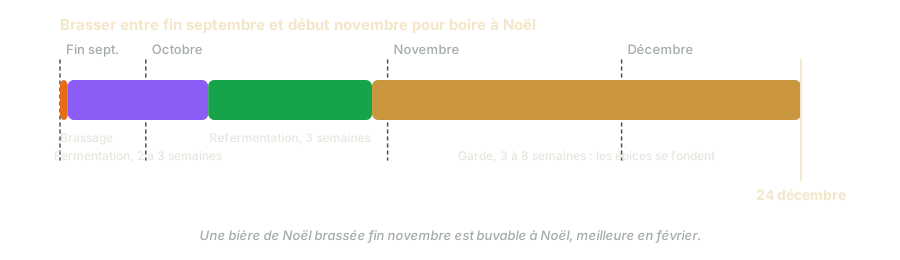
A Christmas beer is drunk at Christmas, not when it comes out of the fermenter. For a 7 to 8 % beer to drink on 24 December:
- Fermentation: 2 to 3 weeks (high gravities take longer, and the yeast must be allowed to finish).
- Bottle conditioning: 3 weeks minimum at 20 °C to take on its gas.
- Ageing: 3 to 6 weeks for the spices to blend in and the alcohol to round off. A young Christmas beer smells of alcohol and raw spices; the same beer a month later is round.
That is 8 to 12 weeks in total: brew between late September and early November. Brewed at the end of November, it will be drinkable at Christmas but better in February. In the app, you can ask Krausi to put these reminders (racking, bottling, first tasting) in the calendar from the date of the batch.
The profile
| Measure | Usual range | Note |
|---|---|---|
| Original gravity | 1.060 to 1.085 | Above 1.085, fermentation needs a starter or two sachets of yeast |
| Final gravity | 1.010 to 1.018 | Belgian yeasts attenuate a lot; a high final gravity gives a heavy beer |
| Alcohol | 6.5 to 9 % ABV | |
| Bitterness | 20 to 35 IBU | The spices and the malt carry the beer, not the hops |
| Colour | 30 to 60 EBC | Dark amber to brown |
| Carbonation | 2.4 to 3 volumes of CO2 | Thick bottles above 2.8 |
The malts
- Base: pilsner or pale ale malt for 75 to 85 % of the grist. That is the classic Belgian base.
- Roundness: Munich or Vienna malt, 10 to 15 %, for toast and colour.
- Caramel and dried fruit: caramunich or cara amber 5 to 8 %, and above all 2 to 3 % of Special B, the malt that gives the raisin and plum of dark Belgian beers. Above 10 % caramel malts in total, the beer becomes cloying.
- Colour without roast: a little dehusked chocolate malt or Carafa Special (1 to 2 %) darkens the beer without a coffee taste, which does not go with spices.
- Sugar: 5 to 10 % of dark candi sugar, brown sugar or white sugar. It raises the alcohol without weighing down the body and gives, for dark candi, notes of caramel and rum. It is the secret of the drinkability of strong Belgian beers.
The hops
A single bittering addition at the start of the boil, with a neutral hop (Magnum, Hallertau Magnum, Northern Brewer, Target), for 25 to 30 IBU. A small aroma addition at the end of the boil with a noble or English hop (Saaz, Styrian Goldings, East Kent Goldings) is possible, but pointless if you spice. No dry hopping: fresh hop aromas clash with the spices and disappear during ageing anyway.
The spices: less than you think
Basic rule: you should guess at the spices, not identify them one by one. The doses below are for 20 litres, added in the last 10 minutes of the boil (heat extracts the oils, and 10 minutes are enough) or steeped in a little neutral spirit added at bottling, which lets you taste and adjust the dose.
| Spice | Dose for 20 L | What it brings |
|---|---|---|
| Cinnamon (stick, not ground) | 1 stick, i.e. 5 to 8 g | Warmth, pastry; quickly overpowering |
| Bitter or sweet orange peel | 15 to 25 g, dried | Freshness, a link with the Belgian yeast |
| Coriander seed, crushed | 10 to 15 g | Citrus, mild pepper |
| Star anise | 1 star | Liquorice; a second star dominates everything |
| Clove | 2 to 3 cloves | Warm spice; the Belgian yeast already produces some |
| Fresh ginger | 10 to 15 g | Heat; prefer it to ground |
| Cardamom | 3 to 4 pods | Floral, lemony |
| Vanilla | Half a split pod, at bottling | Roundness; pairs with the candi sugar |
Choose three spices at most. A combination that works: cinnamon, orange peel, a little coriander. Belgian yeast, fermented a little warm, already brings banana and clove: many renowned Belgian Christmas beers have no added spice at all.
The yeast and fermentation
An abbey or strong Belgian yeast (attenuation 78 to 85 %, tolerance 10 to 12 % alcohol), or an English yeast if you want a rounder, less fruity beer. For a gravity of 1.070 and above, a single 11 g sachet of dry yeast underpitches: plan for two sachets or a starter, calculated with the yeast pitching rate tool. Start fermentation at 18-19 °C for the first three days to limit fusel alcohols, then let it rise freely to 22-24 °C: Belgian yeasts finish better in the warm. Check the final gravity over three days before bottling: a strong beer that has not finished in the bottle means the risk of exploding bottles.
Worked example for 20 litres
Assumptions of the tools: efficiency 72 %, volume in the fermenter 20 L, boil gravity 1.072, hop pellets. Figures to recalculate with the site's tools at the time of publication.
- 5.0 kg pilsner malt
- 0.6 kg Munich malt
- 0.4 kg caramunich (120 EBC)
- 0.15 kg Special B
- 0.3 kg dark candi sugar, added 10 minutes before the end of the boil
- 25 g Magnum at 12 % alpha acids, 60 minutes
- 1 cinnamon stick, 20 g orange peel, 10 g coriander, 10 minutes
- Strong Belgian yeast, two sachets or a starter
| Estimated result | Value | Tool formula |
|---|---|---|
| Original gravity | 1.072 | points = Σ(kg × yield × 384 × efficiency) / volume; sugar at efficiency 1 |
| Final gravity (82 % attenuation) | 1.013 | OG − (OG − 1) × attenuation |
| Alcohol | 7.7 % ABV | (OG − FG) × 131.25 |
| Bitterness | 30 IBU | Tinseth, pellets × 1.10 |
| Colour | about 40 EBC | Morey |
| BU:GU ratio | 0.42 | IBU / gravity points: a malty beer |
| Priming for 2.6 volumes | about 135 g of dextrose for 20 L at 20 °C | priming tool |
Mash at 66 °C for 60 minutes for a beer that finishes dry despite its gravity; 68 °C for more body. A 75-minute boil with pilsner malt (DMS, see off-flavours).
Variations
- English version, Winter Warmer: no spices, pale ale and crystal malt, English yeast, 6 to 7 %, a little more hops (30 to 40 IBU).
- Light amber version for meals: gravity 1.060, 6 %, spices halved.
- Version with dried fruit or honey: 300 g of honey at the end of the boil replaces the sugar, with the same effect on alcohol (the priming by sugar type tool for sugar equivalences).
Common mistakes
- Too much spice, or ground spices, which cloud the beer and dominate everything.
- A single sachet of yeast on 1.075: slow fermentation, acetaldehyde, high final gravity.
- Brewing too late, and serving at Christmas a beer that smells of alcohol.
- Too much caramel malt: a sweet, heavy beer you do not finish.
- Bottling before the end: with 7 to 8 % alcohol and 2.8 volumes of CO2, an unplanned refermentation breaks the bottles.
In the app
What Krausi does
In the app, asking "put together a Christmas beer for 20 litres" first gives a proposal, scaled to the volume and to the measured efficiency of the set-up, with the mash steps and a comparison with the stock; Krausi creates the recipe once the proposal is confirmed. The estimated IBU are recalculated as soon as the real alpha of the packet is entered, and the spices are noted in the recipe as adjuncts.
Frequently asked questions
When should you brew your Christmas beer?
Between late September and early November, for 8 to 12 weeks between the brew and the glass.
Which spices go in a Christmas beer?
Three at most: cinnamon stick, orange peel and coriander are the base. Doses for 20 litres in the table above.
What alcohol level for a Christmas beer?
6.5 to 9 % in general. The example in this article comes to 7.7 %.
Do you need a particular yeast?
A strong Belgian or abbey yeast, in sufficient quantity (two sachets or a starter above 1.070).
How long does a Christmas beer keep?
A year without any problem, cool and in the dark; it improves for 3 to 6 months.
Other articles
Ready for your next brew?
Create your account, describe your first recipe to Krausi, and let him do the maths.