
All about beer
Cardboard or sherry taste: oxidation
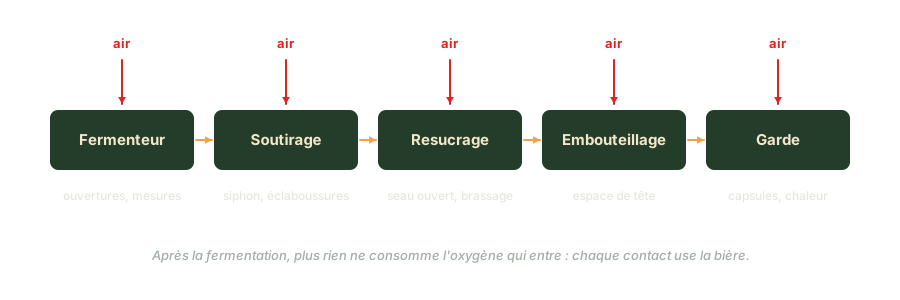
Oxidation is the most widespread fault of homebrew, and the least noticed, because it does not make the beer bad all at once: it wears it down. An IPA that smelled of citrus at racking smells of tired hops three weeks later, a blonde takes on a background of wet cardboard, a strong beer turns to sherry and old honey. Oxygen is welcome once only in the life of a beer, in the cooled wort just before the yeast; every contact afterwards is one contact too many. This page describes where it gets in and how to avoid it with the equipment you have.
Updated on 23 October 2026
What happens
Dissolved oxygen reacts slowly with the beer's compounds: the malt's fatty acids give trans-2-nonenal (cardboard, paper); alcohols oxidise into aldehydes (sherry, bruised apple); the polyphenols of malt and hops brown and give a haze; hop oils break down and the aroma disappears; the melanoidins of dark malts produce notes of caramel and dried fruit, the only ones that are sometimes sought after in a strong beer for ageing. These reactions are irreversible and heat speeds them up: a beer at 25 °C oxidises three to four times faster than at 10 °C.
Two distinct moments:
- Hot side, before and during the boil: oxidation of the wort (splashing when transferring from the mash tun, wort falling from a height) has a debated effect for the home brewer; the breweries that hunt it down do so for very pale beers. It is not the priority.
- Cold side, after fermentation: this is where everything happens. There is no more active yeast to consume the oxygen that gets in, and the hop aromas are the first hit.
Where oxygen gets in
| Moment | What lets air in | What you can do |
|---|---|---|
| Opening the fermenter | Repeated gravity readings, "to have a look", adding the dry hop | Measure little, prepare everything before opening, close again in under a minute; add the dry hop while fermentation is still producing CO2 |
| Racking | Siphon sucking in air through a seal, beer splashing into the second vessel, tube ending above the liquid | Tube down to the bottom of the receiving vessel, slow flow, tight seals; avoid needless racking to a "secondary" |
| Priming | Beer transferred into an open bucket to mix the sugar, stirred vigorously | Pour the sugar syrup into the bottom of the bucket and run the beer onto it from the bottom; mix with a single slow movement with a sanitised spoon |
| Bottling | Filling from the top that foams, 5 cm headspace, bottles left open for ten minutes | Filling wand down to the bottom, fill to 2-3 cm from the rim, cap at once; refermentation consumes the oxygen in the headspace, which makes the bottle more tolerant than an unpurged keg |
| Kegging | Keg filled in the open air, headspace not purged | Purge the keg with CO2 before filling, fill through the dip tube, purge the headspace |
| Storage | Caps that let in a little air over time, bottles in the warm | Store cool (10-14 °C) and in the dark, new caps; drink hoppy beers within two months |
The most sensitive beers
- IPAs and all dry-hopped beers: the hop aroma is destroyed first. That is why a commercial IPA has a short date.
- Very pale, light beers: the cardboard has nothing to hide behind.
- Lagers: clean and crisp, they show everything.
- Strong, dark beers are the most tolerant; some (barley wine, old ale, Christmas beer) even gain port-like notes over a year.
Recognising an oxidised beer
- On the nose: wet cardboard, paper, sometimes old honey or sherry. Compare with a bottle kept cold since bottling, if one is left: the difference is striking.
- To the eye: the beer has browned by a shade or two compared with racking; a pale beer turns light amber.
- Over time: the fault increases week after week, which sets it apart from a fermentation fault, present from the start and stable.
- What it is not: a green-apple taste alone is acetaldehyde (beer too young), even if oxidation can bring it back later.
Brewery methods, within the home brewer's reach
- Closed transfers: connect the fermenter to the keg or the second vessel by a tube, pushing the beer with the CO2 of fermentation or a small gas bottle, without ever exposing it to air. Possible as soon as you have a keg.
- Dry hop under CO2: add the hops during active fermentation, or purge the headspace after the addition.
- Purging the bottles: a jet of CO2 into each bottle before filling, if you have gas; otherwise, rely on refermentation.
- Antioxidants: potassium metabisulphite in small quantity at bottling (a knife tip for 20 L) consumes oxygen; ascorbic acid alone is ineffective and can even make things worse.
- Cold: the only method that works for sure on what you have already bottled. Every degree counts.
In the app
What Krausi does
The batch log accepts dated notes alongside the measurements: noting each transfer and each opening of the fermenter there helps find the step at fault when the tasting sheet reports oxidation. On request, Krausi sets a reminder to taste a very hoppy beer early.
Frequently asked questions
Can an oxidised beer be saved?
No, the reactions are irreversible. You slow down what follows by putting it in the cold, and you drink it.
Should you do a secondary fermentation?
For most beers, no: the transfer to a second vessel lets air in for a gain in clarity that cold conditioning gives as well. It still makes sense for beers on fruit or very long ageing.
How long does a homemade IPA keep?
It is at its best within 4 to 8 weeks after bottling, kept cool. After three months, the hop aroma has largely disappeared.
Is oxidation dangerous?
No, it is a taste fault, not a health problem.
How do I know whether it is oxidation or the yeast giving the taste?
Oxidation increases with time and heat; a yeast fault (solvent, sulphur, butter) is present from racking and stable or decreasing.
Other articles
Ready for your next brew?
Create your account, describe your first recipe to Krausi, and let him do the maths.