
All about beer
Fermenting a lager at 10, 14, 18 or 23 °C
The rule says a lager ferments between 9 and 13 °C. It is right, but it assumes a cellar or a temperature-controlled fridge that many brewers do not have. Yet temperature is only one of the settings: the yeast strain, the dose, pressure and conditioning time make it possible to brew a clean beer well above 13 °C. This page starts from the temperature you can really hold and gives, for each case, the yeasts that suit it, the timetable and what to expect from the result. The classic method is detailed in brewing a lager at home, the yeasts one by one in lager yeasts.
Updated on 11 November 2026
First, measure the real temperature
- It is the temperature of the wort that counts, not that of the room. Fermentation gives off heat: at the height of activity, a 20-litre fermenter is 1 to 3 °C warmer than the air around it. A room at 20 °C therefore gives a beer at 21-23 °C during the days that matter most.
- Measure on the fermenter: a probe held against the wall under a piece of insulating foam, or a stick-on thermometer, halfway up the liquid.
- Check the place before brewing: a min-max thermometer left for a week tells you what the cellar, garage or pantry really holds, night and day.
- Stability counts as much as the value: a constant 15 °C is better than 11 °C at night and 17 °C in the afternoon.
- The first three or four days decide the flavour: esters and fusel alcohols form while the yeast is multiplying. If you can only cool for a few days (a tub of water and frozen bottles), that is when to do it.
The four cases at a glance
| Wort temperature | Typical situation | Suitable yeasts | From brew to glass | Expected result |
|---|---|---|---|---|
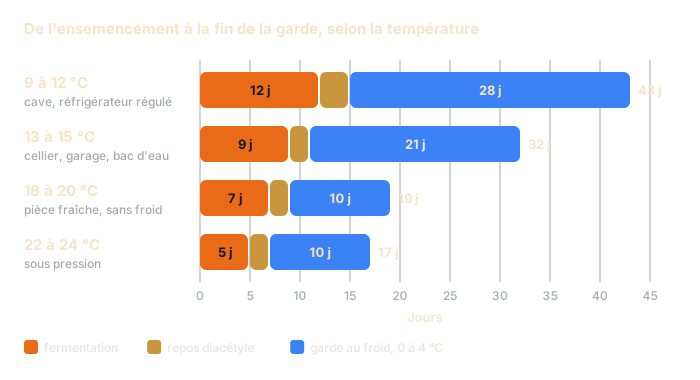
| 9 to 12 °C | Cellar in winter, controlled fridge | All lager yeasts | 8 to 12 weeks | The classic lager, the cleanest |
| 13 to 15 °C | Pantry, garage, tub of water | W-34/70, S-189, Diamond, NovaLager | 6 to 8 weeks | Very close, a little more sulphur at the start |
| 18 to 20 °C | Cool room, no cooling | NovaLager, M54, WLP810, Wyeast 2112, W-34/70 (with or without pressure) | 4 to 6 weeks | Clean, slightly fruitier |
| 22 to 24 °C | Heated room, summer | W-34/70 or NovaLager under pressure; or Lutra kveik | 3 to 5 weeks | A clean lager-type beer, not a lager in the strict sense |
9 to 12 °C: the classic route
This is the reference, the one breweries use and the one that forgives the least.
- Yeasts: every lager strain is at ease here. The all-round German strains (SafLager W-34/70, LalBrew Diamond, WLP830, Wyeast 2124), the maltier Bavarian ones (Mangrove Jack's M76, Wyeast 2206), the Czech ones (M84, WLP800, Wyeast 2278).
- Dose: double that of an ale, that is two sachets of dry yeast for 20 litres at 1.050, or a starter for a liquid yeast. At this temperature, too small a dose is the first cause of sulphur, green apple and butter.
- Pitch into wort already cooled to 10-12 °C, not at 20 °C "to get it going".
- Fermentation of 10 to 14 days, then a diacetyl rest at 17-18 °C for 2 to 3 days when the gravity is 2 to 4 points from final.
- Cold conditioning for 3 to 8 weeks at 0-4 °C.
- What you get: the most neutral profile, malt and hops laid bare. What it costs: cold for two months, and patience.
The full timetable, day by day, is in brewing a lager.
13 to 15 °C: the cool cellar or pantry
This is the most common situation from November to March in an unheated room, and it is good news: most modern lager yeasts are rated for this range by their maker.
- Yeasts: SafLager W-34/70, S-189 and S-23 are rated by Fermentis for 12 to 18 °C; LalBrew Diamond for 10 to 15 °C; LalBrew NovaLager for 10 to 20 °C; Mangrove Jack's M84 for 10 to 15 °C. At 14 °C, all are within their range.
- To avoid at this temperature: S-23, the fruitiest of the lot, if you want a very neutral beer; the Bavarian strains rated for 8 to 14 °C (M76, Wyeast 2206) are at their upper limit.
- Dose: still two sachets for 20 litres. The yeast multiplies a little faster than at 10 °C, but the maker's dose stays the same across its whole range.
- Fermentation of 7 to 10 days. The diacetyl rest becomes a simple precaution: let it rise to 17-18 °C for two days at the end of fermentation, or do the heated-sample test (see off-flavours).
- Cold conditioning for 2 to 4 weeks.
- What you get: a lager that few tasters will tell from the previous one. The sulphur smell during fermentation is often stronger; it goes during conditioning.
18 to 20 °C: no cooling
Here you leave the classic range, and three routes exist. None is cheating: they are three different ways of getting a clean beer.
A tolerant lager yeast, without pressure
- The Fermentis dry strains are rated up to 18 °C, and the maker states that W-34/70 keeps its neutral profile when the temperature goes up, with simply a shorter fermentation. It is the strain most used for lagers "at ale temperature".
- LalBrew NovaLager is designed for this: a range of 10 to 20 °C, no sulphur, little diacetyl, low to medium esters. Lallemand presents it as a modern hybrid lager yeast.
- Fermentation of 5 to 8 days, no separate diacetyl rest (the beer is already there), cold conditioning for at least one to two weeks.
- Result: a clean beer, a little rounder and slightly fruitier than a lager fermented at 10 °C. In a very pale pils, the difference shows; in an amber or a dark beer, much less.
A "California" yeast, made for this range
- These are lager yeasts long selected to ferment warm, those of the California common style: Mangrove Jack's M54 (18 to 20 °C), White Labs WLP810 (14 to 18 °C), Wyeast 2112 (14 to 20 °C).
- They need neither long conditioning nor a particular rest, and leave a clean beer with a light fruitiness and a slightly maltier finish (their attenuation is lower than that of the German strains).
A lager yeast under pressure
- In a fermenter designed for pressure, under 0.8 to 1 bar after a first day with the valve open, the dissolved CO2 slows the yeast's multiplication and therefore the esters. The settings and the safety rules are in fermenting under pressure.
- At 18-20 °C, what pressure adds to the flavour is real but modest: with a tolerant strain like W-34/70, blind tastings among home brewers have not always told the beer fermented under pressure from the same beer without. The choice of strain counts at least as much.
- Its real advantages at this temperature lie elsewhere: carbonation in the fermenter, oxygen-free transfer, a beer ready in three weeks.
And the "mock lagers"
A very neutral ale yeast fermented at the bottom of its range also gives a beer close to a lager: a kölsch yeast (WLP029 at 18-20 °C, Wyeast 2565 from 13 °C), or Lutra kveik, clean from 20 °C. These are not lagers, since the yeast is not the same species, but in the glass the gap is small.
22 to 24 °C: the limit
At 23 °C, you are above the range stated by every maker of lager yeast (18 °C at Fermentis, 20 °C for NovaLager). It is possible, brewers routinely do it under pressure, but you should know it: the result is no longer guaranteed by the data sheet.
- Under pressure, with a tolerant strain: SafLager W-34/70 or LalBrew NovaLager, two sachets for 20 litres, valve open until fermentation starts (often less than 12 hours at this temperature), then 1 bar. Fermentation of 4 to 6 days. Here pressure is what limits esters and fusel alcohols; without it, the result clearly gets worse.
- What pressure does not rescue: beyond 24-25 °C, the beer takes on a hot, solventy character, and the sulphur stays. In a blind comparison among home brewers, the same W-34/70 fermented without pressure at 16 °C and at 27 °C gave two beers that tasters could tell apart, the warmer one keeping a note of sulphur.
- Without a pressure fermenter: change yeast rather than force a lager. Lutra kveik is rated for 20 to 35 °C and stays neutral; at 23 °C it makes a clean thirst-quenching beer in a few days (see brewing with a kveik, it needs nutrients). A neutral American ale yeast also works.
- In every case, keep one to two weeks of cold conditioning after fermentation: that is what drops the yeast and drives off the sulphur.
- What you get: a pale, clean, refreshing beer that you can call a lager at the table without blushing, but that would not pass for a German pils with a judge. Choose a recipe that suits it: an amber lager, a hoppy blonde, rather than a helles where nothing can hide.
Raising the temperature along the way: the "fast lager"
When you have cold available, but not for two months, you can shorten the classic method without changing the result. The principle: the yeast makes its aromas during the first days; once half the sugars are consumed, raising the temperature adds almost no more esters and speeds up the end.
- Pitch and ferment at 10-12 °C until mid-fermentation (for example 1.030 for a wort at 1.050 that should finish at 1.010), that is 4 to 6 days.
- Let it rise by 2 to 3 °C a day up to 18-20 °C, and stay there until the final gravity is stable: the diacetyl rest is included.
- Cool towards 0-2 °C, condition for one to two weeks.
- Total: about four weeks until bottling or kegging, instead of six to eight.
What does not change, whatever the temperature
- Pitch at the planned fermentation temperature, or a little below, never above.
- The yeast dose: that of a lager. The pitching rate tool gives the number of sachets for the volume and the gravity.
- Check the diacetyl before cooling: a sample heated to 60 °C for 15 minutes in a covered glass, then cooled, must not smell of butter.
- Cold conditioning: shorter when you fermented warm, but never zero.
- Add a pinch of yeast at priming if the beer has spent more than two or three weeks in the cold (see flat beer or too much foam).
Common mistakes
- Trusting the room temperature: the wort is 1 to 3 °C warmer at the critical moment.
- Taking a classic Bavarian or Czech strain to ferment at 20 °C: they are not made for that, choose a tolerant strain.
- Pitching warm then cooling: the esters are already there.
- Reducing the yeast dose because it is warmer.
- Counting on pressure to rescue 26 °C.
- Skipping cold conditioning because fermentation was fast: a hazy, sulphury beer.
- Letting the temperature swing: a slightly high, stable temperature is better.
In the app
What Krausi does
A recipe sheet works out the number of yeast sachets for the planned volume and gravity, taking into account that the yeast is a lager. During fermentation, a temperature probe or a connected hydrometer attached to the brew plots the temperature and the gravity on the fermentation curve, which shows whether the wort temperature really holds. You can ask Krausi to set the reminders of the timetable you chose (raise the temperature, check the diacetyl, cool, bottle) and to suggest equivalents for a yeast you cannot find.
Frequently asked questions
Can you make a lager at room temperature?
Yes, at 18-20 °C with a tolerant lager yeast (W-34/70, NovaLager) or a California-type yeast (M54, WLP810, Wyeast 2112). The beer is clean, a little fruitier than a lager fermented at 10 °C. Above 22 °C, you need pressure or another yeast.
Which lager yeast copes best with heat?
Among dry yeasts, LalBrew NovaLager (10 to 20 °C according to its maker) and SafLager W-34/70 (12 to 18 °C, reputed to stay neutral above). Among liquid ones, the California strains, rated up to 18-20 °C.
Does pressure fermentation let you ferment a lager at 23 °C?
It makes it possible with a tolerant strain, under about 1 bar, and many home brewers do it. It is above the makers' range: the result is a clean beer, but less fine than at 12 °C, and it gets worse quickly beyond 24-25 °C.
Do you need a diacetyl rest when fermenting at 18 °C?
No separate rest: the beer is already at the rest temperature. Just leave it two to three days after the end of fermentation and do the heated-sample test before cooling.
At 14 °C, is it still a real lager?
Yes. Most dry lager yeasts are rated for this temperature by their maker, and the result is very close to a fermentation at 10 °C.
Other articles
Ready for your next brew?
Create your account, describe your first recipe to Krausi, and let him do the maths.