
All about beer
Lager yeasts
A lager is neither a colour nor a strength: it is a beer fermented by a lager yeast, then conditioned cold. This yeast is a species of its own, born of a cross, that works where an ale yeast goes to sleep. This page explains what makes it different, what separates it from the ale yeasts, hybrid yeasts and kveiks sometimes used in its place, then reviews the strains found on the market, with the temperature range stated by their maker. The yeast families as a whole are in beer yeasts.
Updated on 11 November 2026
A hybrid yeast
- Ale yeast is called Saccharomyces cerevisiae: it is also the yeast of bread and wine. Lager yeast is called Saccharomyces pastorianus (long named S. carlsbergensis, after the brewery where it was isolated in pure culture in 1883).
- S. pastorianus is a natural hybrid between ale yeast and a wild yeast that likes the cold, Saccharomyces eubayanus, described in 2011 from strains found on beech trees in Patagonia. The cross happened in the cellars of Central European brewers, somewhere between the 15th and 16th centuries, when Bavaria required brewing in winter and keeping the beer cool.
- From its ale parent, it gets the ability to ferment the sugars of malt, maltotriose included. From its wild parent, it gets its tolerance of the cold.
- There are two historical lineages. Group I, called Saaz, kept more of the wild parent: it copes better with the cold but ferments less completely. Group II, called Frohberg, has more of the ale parent: a more vigorous fermentation, better tolerance of temperature and alcohol. Almost all lager yeasts sold today are Frohberg, including the famous 34/70 strain from Weihenstephan.
- A third group appeared recently through classical selection, without genetic modification: hybrids that are three quarters ale parent. LalBrew NovaLager is the first commercial example.
What sets it apart in practice
- It works in the cold: 9 to 13 °C in the classic method, where an ale yeast slows down then stops. It also works warmer, but it is in the cold that it is most neutral.
- It produces very few esters: no fruitiness, no banana, no spice. Malt and hops are laid bare, which makes faults audible.
- It produces sulphur: a smell of egg or struck match during fermentation is normal, stronger than with an ale. It disappears during conditioning.
- It reabsorbs diacetyl (the butter taste) slowly when it is cold: hence the rest at 17-18 °C at the end of fermentation.
- You need more of it: about double an ale at equal gravity when fermenting cold, because it multiplies slowly (see the pitching rate tool).
- It is called "bottom-fermenting" because it forms less foam on the surface and settles at the bottom, whereas many ale yeasts rise to the top. In a home brewer's fermenter, the visible difference is slight.
- It can ferment a sugar, melibiose, that ale yeast leaves: this is the laboratory test that separates the two, with no consequence for the brewer.
Lager, ale, hybrid, kveik: who does what
| Yeast | Species | Usual temperature | Character |
|---|---|---|---|
| Lager | S. pastorianus | 9 to 15 °C, up to 18-20 °C for tolerant strains | Neutral, passing sulphur, needs conditioning |
| Neutral ale (American) | S. cerevisiae | 18 to 22 °C | Clean, light fruitiness, ready quickly |
| "Cold" ale (kölsch, altbier) | S. cerevisiae | 13 to 20 °C | Almost as clean as a lager, a discreet apple or pear fruitiness, often sulphur |
| Neutral kveik (Lutra) | S. cerevisiae | 20 to 35 °C | Very clean even warm, ferments in a few days |
- The historical hybrid styles cross the two worlds in one direction or the other. California common ferments a lager yeast at ale temperature. Kölsch and altbier ferment an ale yeast cool, then are conditioned cold like lagers.
- A "pseudo-lager" is a beer with a lager recipe fermented with a very neutral ale yeast or a clean kveik. It is not a lager, since the yeast is not one, but it is often the best answer when you cannot get below 22 °C (see fermenting a lager at the temperature you have).
- What the substitutes do not quite imitate: the touch of sulphur and the crisp dryness of a true lager, which are part of the style in a pils or a helles.
The strains to know
The temperature ranges and the attenuations are those of the makers. An "ideal" range is not a limit: it says where the maker guarantees the profile.
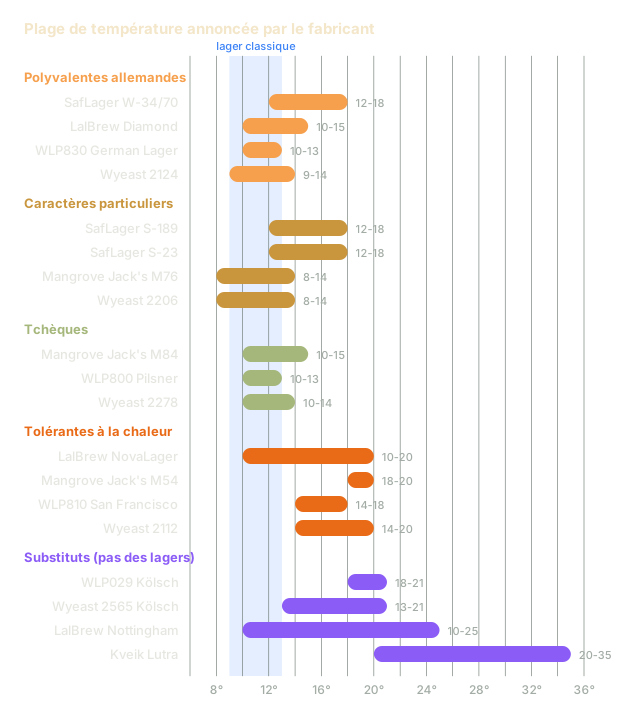
The all-round German strains
Those you can do everything with, from pils to doppelbock. The ones to pick for a first lager.
- Fermentis SafLager W-34/70 (dry, 11.5 g). The Weihenstephan strain, the most widely used lager yeast in the world. Ideal range 12 to 18 °C, attenuation 80 to 84 %, fast sedimentation. Neutral, balanced, tolerant: it is the one to choose for fermenting at 15-20 °C or under pressure.
- Lallemand LalBrew Diamond (dry, 11 g). A German strain of the Frohberg group. 10 to 15 °C, attenuation 77 to 83 %, high flocculation. Very neutral, gives a bright beer; keep it within its range.
- White Labs WLP830 German Lager (liquid). 10 to 13 °C, attenuation 74 to 79 %, medium flocculation. The laboratory's best-selling lager yeast, reputed to have the same origin as W-34/70.
- Wyeast 2124 Bohemian Lager (liquid). 9 to 14 °C, attenuation 73 to 77 %. Despite its name, it is reputed to be of the same family as the two above.
The particular characters
- Fermentis SafLager S-189 (dry). From the Hürlimann brewery, in Switzerland. 12 to 18 °C, attenuation 80 to 84 %. Neutral with herbal and floral notes, at ease in strong beers (bocks) and malty lagers.
- Fermentis SafLager S-23 (dry). A strain of Berlin origin. 12 to 18 °C. The fruitiest of the three Fermentis strains, with more esters: good for a hoppy or fruity lager, less so for a helles.
- Mangrove Jack's M76 Bavarian Lager (dry, 10 g). 8 to 14 °C, attenuation 75 to 80 %. Less sulphur than average, a rounder malt: helles, dunkel, märzen, bocks.
- Wyeast 2206 Bavarian Lager (liquid). 8 to 14 °C, attenuation 73 to 77 %. The strain of malty beers and bocks; needs a careful diacetyl rest.
The Czech strains
- Mangrove Jack's M84 Bohemian Lager (dry). 10 to 15 °C, attenuation 72 to 76 %. A soft, round finish, for Czech pils and amber lagers.
- White Labs WLP800 Pilsner Lager (liquid). 10 to 13 °C, attenuation 72 to 77 %. Leaves a little malt and a slightly sweet finish, in the spirit of Bohemian pils.
- Wyeast 2278 Czech Pils (liquid). 10 to 14 °C, attenuation 70 to 74 %. Dry but malty; a lot of sulphur during fermentation, which goes during conditioning.
The heat-tolerant strains
Those you choose when you cannot hold 12 °C.
- Lallemand LalBrew NovaLager (dry). A modern hybrid of the third group. 10 to 20 °C, attenuation 78 to 84 %, no sulphur, little diacetyl, low to medium esters. Ferments fast: about six days at 12 °C according to the maker. Tolerates up to 13 % alcohol.
- Mangrove Jack's M54 Californian Lager (dry). 18 to 20 °C, attenuation 77 to 82 %. A lager yeast made for ale temperature, without long conditioning.
- White Labs WLP810 San Francisco Lager (liquid). 14 to 18 °C, attenuation 70 to 75 %, high flocculation. The yeast of California common; colder, it also makes märzen and helles.
- Wyeast 2112 California Lager (liquid). 14 to 20 °C, attenuation 67 to 71 %. Same use, malty finish.
- And W-34/70, already mentioned, which keeps a neutral profile at the top of its range.
The substitutes that are not lagers
- Kölsch yeasts: White Labs WLP029 (18 to 21 °C, ferments poorly below 17 °C), Wyeast 2565 (13 to 21 °C). Ale yeasts with a profile close to a lager, to be conditioned cold afterwards.
- Lutra kveik (Omega OYL-071, liquid or dry). 20 to 35 °C, attenuation 75 to 82 %. At the bottom of its range, its maker itself presents it as a pseudo-lager yeast.
- Lallemand LalBrew Nottingham (dry). A very neutral English ale yeast, rated for 10 to 25 °C, which Lallemand classes as a pseudo-lager when fermented cool.
How to choose
- First lager, cellar at 10-14 °C: W-34/70 or Diamond, two sachets for 20 litres.
- Czech pils, round amber lager: a Czech strain (M84, WLP800, Wyeast 2278).
- Helles, märzen, dunkel, bocks: a Bavarian strain (M76, Wyeast 2206) or S-189.
- No cooling, 18-20 °C: NovaLager, M54, or W-34/70.
- Under pressure: W-34/70 or NovaLager.
- Above 22 °C without pressure: a Lutra kveik or a neutral ale, accepting that it is not a lager.
Equivalences between brands (which dry yeast replaces which liquid one) can be looked up in the ingredient equivalents tool. Two "equivalent" strains often come from the same original brewery, but each laboratory has selected its own: the attenuation and temperature figures are never quite the same.
Dry or liquid, and how much
- Dry lager yeasts are the simple choice today: two sachets for 20 litres at 1.050, no starter, and no need to oxygenate the wort, since dry yeast comes with its reserves.
- A liquid lager yeast almost always needs a starter of 2 to 3 litres for 20 litres, prepared two to three days ahead, and well-oxygenated wort (see the yeast starter tool).
- For a beer above 1.060 (bocks, doppelbock, Baltic porter), allow three sachets or a bigger starter: it is the gravity, more than the cold, that puts the yeast in difficulty.
- A lager yeast reuses very well: the yeast cake of a light helles is the best starter there is for a bock brewed on racking day.
Common mistakes
- A single sachet for 20 litres at 10 °C: slow start, sulphur, green apple.
- Worrying about the egg smell and throwing the batch away: it is normal and goes during conditioning.
- Choosing a Bavarian strain rated for 8 to 14 °C and fermenting it at 20 °C.
- Believing that a yeast labelled "lager" is enough to make a lager: without cold conditioning, the beer stays hazy and sulphury.
- Bottling without checking the diacetyl after a cold fermentation.
In the app
What Krausi does
When you add a yeast to a recipe, Krausi takes the attenuation from its sheet and the recipe works out the number of sachets for the volume and the gravity, with a lager's rate if the yeast is one. The equivalents tool, on the site and in the app, suggests the strains close to a given yeast, including among those you have in stock.
Frequently asked questions
What is the difference between a lager yeast and an ale yeast?
They are two species. Lager yeast, Saccharomyces pastorianus, is a hybrid that ferments in the cold (9 to 15 °C), produces very few esters and needs conditioning; ale yeast, S. cerevisiae, ferments at 18-22 °C and gives more fruitiness.
Which lager yeast should a beginner choose?
An all-round dry yeast: SafLager W-34/70 or LalBrew Diamond, two sachets for 20 litres. Without cooling, LalBrew NovaLager or Mangrove Jack's M54.
Can you use a lager yeast at 20 °C?
Some, yes: NovaLager is rated for 10 to 20 °C, the California strains for 18 to 20 °C, and W-34/70 stays neutral at the top of its range. The classic Bavarian and Czech strains should be kept below 14-15 °C.
Why does my lager yeast smell of sulphur?
All lager yeasts produce some during fermentation, some more than others. The smell disappears in one to three weeks of cold conditioning. It lingers above all when the yeast dose was too small.
Are W-34/70, WLP830 and Wyeast 2124 the same yeast?
They are reputed to descend from the same Weihenstephan strain, but each laboratory maintains its own. They can replace each other without changing the recipe; their stated temperature ranges and attenuations differ a little.
Other articles
Ready for your next brew?
Create your account, describe your first recipe to Krausi, and let him do the maths.