
5D German Pils
OG 1.044 to 1.050 · FG 1.008 to 1.013 · 22 to 40 IBU · 4 to 8 EBC · 4.4 to 5.2 % ABV
All about beer
For many people, "lager" means a pale, light, industrial beer. It is in fact the largest family of beers in the world, and one of the most varied: it runs from table beer at 3 % to doppelbock at 10 %, from straw yellow to black, from dry, bitter pils to the smoked beer of Bamberg. What unites them is neither colour nor strength, but the yeast and cold conditioning. This page presents the lager families, their figures according to the BJCP guide, their typical ingredients and the difficulty specific to each. The brewing method is in brewing a lager at home.
Updated on 11 November 2026
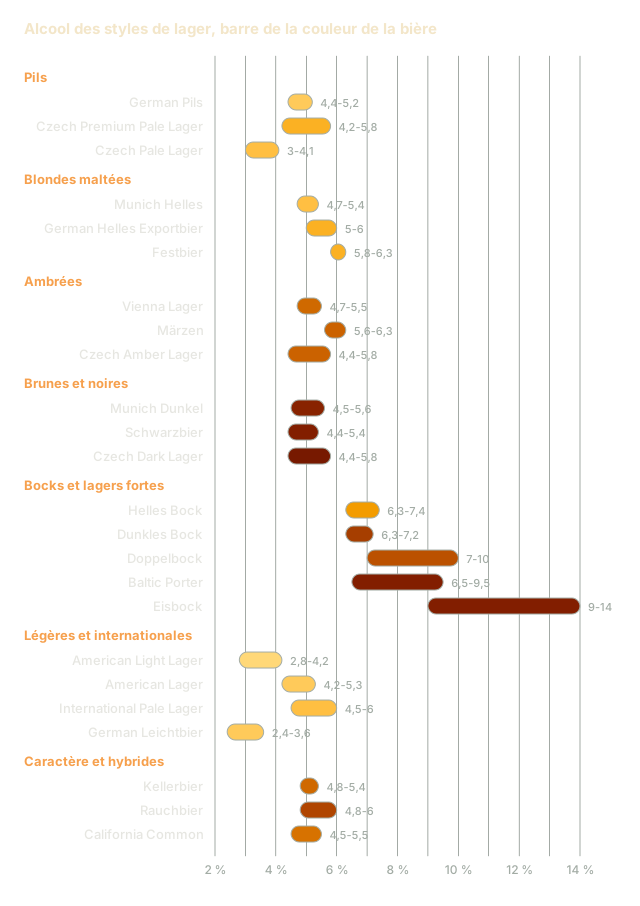
The figures on the cards come from the 2021 BJCP guide: original and final gravity, bitterness, colour and alcohol.
The first pale lager was brewed in Plzeň, in Bohemia, in 1842. All the rest of modern pale beer descends from it. Two schools:
5D German Pils
OG 1.044 to 1.050 · FG 1.008 to 1.013 · 22 to 40 IBU · 4 to 8 EBC · 4.4 to 5.2 % ABV
3B Czech Premium Pale Lager
OG 1.044 to 1.060 · FG 1.013 to 1.017 · 30 to 45 IBU · 7 to 12 EBC · 4.2 to 5.8 % ABV
3A Czech Pale Lager
OG 1.028 to 1.044 · FG 1.008 to 1.014 · 20 to 35 IBU · 6 to 12 EBC · 3.0 to 4.1 % ABV
4A Munich Helles
OG 1.044 to 1.048 · FG 1.006 to 1.012 · 16 to 22 IBU · 6 to 10 EBC · 4.7 to 5.4 % ABV
5C German Helles Exportbier
OG 1.050 to 1.058 · FG 1.008 to 1.015 · 20 to 30 IBU · 8 to 12 EBC · 5.0 to 6.0 % ABV
4B Festbier
OG 1.054 to 1.057 · FG 1.010 to 1.012 · 18 to 25 IBU · 8 to 12 EBC · 5.8 to 6.3 % ABV
7A Vienna Lager
OG 1.048 to 1.055 · FG 1.010 to 1.014 · 18 to 30 IBU · 18 to 30 EBC · 4.7 to 5.5 % ABV
6A Märzen
OG 1.054 to 1.060 · FG 1.010 to 1.014 · 18 to 24 IBU · 16 to 34 EBC · 5.6 to 6.3 % ABV
3C Czech Amber Lager
OG 1.044 to 1.060 · FG 1.013 to 1.017 · 20 to 35 IBU · 20 to 32 EBC · 4.4 to 5.8 % ABV
8A Munich Dunkel
OG 1.048 to 1.056 · FG 1.010 to 1.016 · 18 to 28 IBU · 34 to 55 EBC · 4.5 to 5.6 % ABV
8B Schwarzbier
OG 1.046 to 1.052 · FG 1.010 to 1.016 · 20 to 35 IBU · 37 to 59 EBC · 4.4 to 5.4 % ABV
3D Czech Dark Lager
OG 1.044 to 1.060 · FG 1.013 to 1.017 · 18 to 34 IBU · 34 to 69 EBC · 4.4 to 5.8 % ABV
Born in Einbeck, in northern Germany, then adopted by Munich. Strong, malty, lightly bittered lagers, to drink when it is cold.
6C Dunkles Bock
OG 1.064 to 1.072 · FG 1.013 to 1.019 · 20 to 27 IBU · 28 to 43 EBC · 6.3 to 7.2 % ABV
4C Helles Bock
OG 1.064 to 1.072 · FG 1.011 to 1.018 · 23 to 35 IBU · 12 to 18 EBC · 6.3 to 7.4 % ABV
9A Doppelbock
OG 1.072 to 1.112 · FG 1.016 to 1.024 · 16 to 26 IBU · 12 to 49 EBC · 7.0 to 10.0 % ABV
9B Eisbock
OG 1.078 to 1.120 · FG 1.020 to 1.035 · 25 to 35 IBU · 34 to 59 EBC · 9.0 to 14.0 % ABV
9C Baltic Porter
OG 1.060 to 1.090 · FG 1.016 to 1.024 · 20 to 40 IBU · 34 to 59 EBC · 6.5 to 9.5 % ABV
1A American Light Lager
OG 1.028 to 1.040 · FG 0.998 to 1.008 · 8 to 12 IBU · 4 to 6 EBC · 2.8 to 4.2 % ABV
1B American Lager
OG 1.040 to 1.050 · FG 1.004 to 1.010 · 8 to 18 IBU · 4 to 7 EBC · 4.2 to 5.3 % ABV
2A International Pale Lager
OG 1.042 to 1.050 · FG 1.008 to 1.012 · 18 to 25 IBU · 4 to 12 EBC · 4.5 to 6.0 % ABV
5A German Leichtbier
OG 1.026 to 1.034 · FG 1.006 to 1.010 · 15 to 28 IBU · 3 to 8 EBC · 2.4 to 3.6 % ABV
27A Bière historique : Kellerbier
OG 1.048 to 1.054 · FG 1.012 to 1.016 · 25 to 40 IBU · 14 to 34 EBC · 4.8 to 5.4 % ABV
6B Rauchbier
OG 1.050 to 1.057 · FG 1.012 to 1.016 · 20 to 30 IBU · 24 to 43 EBC · 4.8 to 6.0 % ABV
19B California Common
OG 1.048 to 1.054 · FG 1.011 to 1.014 · 30 to 45 IBU · 18 to 28 EBC · 4.5 to 5.5 % ABV
5B Kölsch
OG 1.044 to 1.050 · FG 1.007 to 1.011 · 18 to 30 IBU · 7 to 10 EBC · 4.4 to 5.2 % ABV
7B Altbier
OG 1.044 to 1.052 · FG 1.008 to 1.014 · 25 to 50 IBU · 18 to 34 EBC · 4.3 to 5.5 % ABV
1C Cream Ale
OG 1.042 to 1.055 · FG 1.006 to 1.012 · 8 to 20 IBU · 4 to 10 EBC · 4.2 to 5.6 % ABV
These styles are the best way in when you cannot hold 12 °C: see fermenting a lager at the temperature you have.
Before artificial cold, lagers were brewed only in winter, and the styles still show it. The home brewer without a dedicated fridge follows the same rhythm:
In the app
In a recipe, you choose the BJCP style from the list: the sheet then compares the estimated gravity, bitterness, colour and alcohol with the bounds of the style and flags what falls outside. You can ask Krausi to compose a recipe for a given style, at your volume and efficiency, then to adjust it. The bounds of every style are also in the styles explorer.
Pils is a style of lager: a pale, dry, distinctly hoppy lager. All pils are lagers, but a helles, a märzen or a bock are lagers that are not pils.
No. Dunkel is brown, schwarzbier and Baltic porter are black, märzen and Vienna are amber. The colour comes from the malts, not from the yeast.
An amber or brown lager (Vienna, märzen, dunkel), where the malt covers small slips, or a California common, which ferments at 14-18 °C. Pils and the very light lagers are the most demanding.
Märzen is amber and malty, it is the old Oktoberfest beer. Festbier, served in Munich today, is pale, lighter in taste, and about as strong.
Strong and malty, they need long cold conditioning: brewed at the start of winter, they are ready for Lent (doppelbock) or for May (Maibock).
Create your account, describe your first recipe to Krausi, and let him do the maths.